USAID DEC
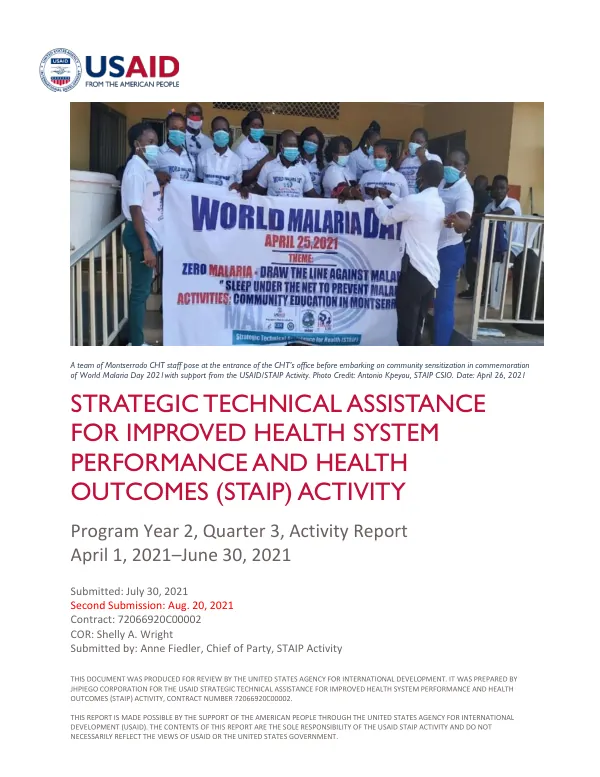
USAID Strategic Technical Assistance for Improved Health System Performance and Health Outcomes (STAIP) Activity, Contract Number 72066920C00002, Activity Report, April 1, 2021–June 30, 2021
Sign inJHPIEGO
USAID Strategic Technical Assistance for Improved Health System Performance and Health Outcomes (STAIP) Activity, Contract Number 72066920C00002, Activity Report, April 1, 2021–June 30, 2021
The Strategic Technical Assistance for Improved Health System Performance and Health Outcomes (STAIP) activity is a four-year project implemented in 12 counties in Liberia.
2021 · 74 pages
Sign in to readA free account is required to download.
Abstract
The project aims to support the Ministry of Health (MOH) in planning, financing, and implementing solutions aligned with the Government of Liberia's development priorities for health. Specifically, STAIP supports strengthening the MOH's systems to improve patient outcomes at primary health care facilities by providing sustainable capacity-building and incentivizing better health systems performance through performance-based financing. The project has three main objectives: to strengthen management capacity of county health teams (CHTs) and select units at MOH to drive health systems performance improvement, to strengthen quality of reproductive, maternal, newborn, child, and adolescent health (RMNCAH) and malaria primary health care services for improved health outcomes, and to increase financial risk protection and improve overall health sector financing. The project is implemented in six Fixed Amount Reimbursement Agreement (FARA) counties and six malaria-focus counties. During the second quarter of program year 2 (PY2 Q3), significant progress was made in achieving the project's objectives. In terms of improving county health team performance, the overall compliance with the 12 public financial management (PFM) functions by the FARA counties observed with an average score of 87% in six counties compared with the previous quarter's score of 85%. Additionally, 87% of risks identified in the CHT Capacity assessment report as "high" have been resolved. The project also made progress in strengthening quality of RMNCAH and malaria primary health care services. The project supported the implementation of performance-based financing operations to drive and incentivize facility-, district-, and county-level systems performance and quality of care. Furthermore, the project supported the establishment and implementation of a responsive technical assistance (RTA) fund to address the needs of the MOH and county health teams. In terms of financial management, the project made significant progress in improving financial risk protection and overall health sector financing. The project supported the implementation of public financial management and support for contracting-in, as well as data visualization, data integration, and DHIS 2.0-related support. The project is implemented by a Jhpiego-led consortium, which includes PricewaterhouseCoopers and BAO Systems. The project has a total budget of $23,720,311, with a total STAIP award of $24,343,148. The project has obligated an amount of $13,253,959 and has expended a total of $7,792,059.63 as of June 2021. The project's geographic scope includes 12 counties in Liberia, with six FARA counties and six malaria-focus counties. The project's cross-cutting intermediate results include improved data quality and use, strengthened performance-based financing operations, and the establishment and implementation of a responsive technical assistance fund.