JHPIEGO
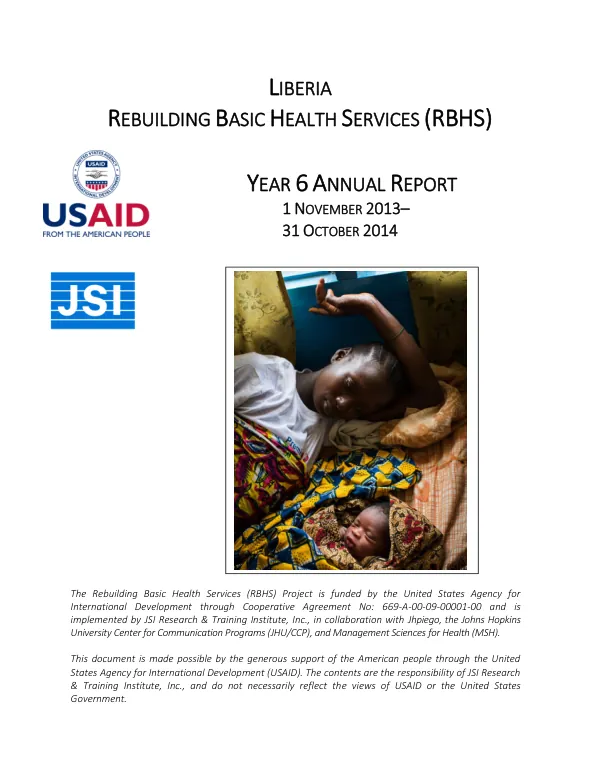
Rebuilding Basic Health Services (RBHS) Year 6 Annual Report
The Rebuilding Basic Health Services (RBHS) Project is a collaborative effort between JSI Research & Training Institute, Inc., Jhpiego, the Johns Hopkins University Center for Communication Programs (JHU/CCP), and Management Sciences for Health (MSH), funded by the United States Agency for International Development (USAID) through Cooperative Agreement No: 669-A-00-09-00001-00.
2014 · 61 pages
Sign in to readA free account is required to download.
Abstract
The project's mission is to support the Ministry of Health and Social Welfare in establishing and maintaining a comprehensive range of high-quality health services for the Liberian people. The project focuses on four key pillars: the Essential Package of Health Services (EPHS), human resources, infrastructure, and support systems. RBHS is committed to the principles of partnership, participation, capacity building, and evidence-based decision making, with a strong emphasis on youth sensitivity and gender equity. The project's goal is to increase access to basic health services and improve the quality of health services through improved infrastructure, health workforce, and systems performance. During the reporting period, November 2013 to October 2014, the project's activities were significantly impacted by the Ebola outbreak in Liberia. As a result, all project activities since June have focused exclusively on epidemic mitigation. Project staff have been actively involved in social mobilization, community health, and reproductive health committees and working groups to support the emergency response. RBHS staff have also played an active role on the National Infection Prevention and Control Task Force, working alongside MOHSW staff and national and international partners to develop a comprehensive training package, including standard operating procedures (SOPs) for various levels of care, job aids, and monitoring tools for health workers. The project has made significant progress in increasing access to basic health services, particularly in the areas of maternal, neonatal, and child health. The project has also strengthened the capacity of the Ministry of Health and Social Welfare to plan, manage, and monitor a decentralized health system. Additionally, the project has improved the quality of health services through the provision of training and technical assistance to health workers. The project's achievements include the establishment of a comprehensive training package for health workers, which includes SOPs, job aids, and monitoring tools. The project has also supported the development of a health information system, which has improved the collection and analysis of health data. Furthermore, the project has strengthened the capacity of the Ministry of Health and Social Welfare to manage and monitor a decentralized health system. The project's geographic focus is Liberia, with a specific emphasis on the counties of Montserrado, Margibi, and Bong. The project's timeframes are from November 2013 to October 2014, with a focus on the Ebola outbreak response during the latter part of the reporting period. The project's recommendations include the continued support for the Ministry of Health and Social Welfare to strengthen its capacity to manage and monitor a decentralized health system, as well as the continued provision of training and technical assistance to health workers. The project's implementation details include the provision of training and technical assistance to health workers, the establishment of a comprehensive training package, and the development of a health information system. The project's methodology includes the use of a participatory approach, which involves the active engagement of community members and health workers in the planning and implementation of project activities. The project's evaluation framework includes the use of indicators to measure progress towards project goals and objectives. The project's geographic context is Liberia, which has a high burden of infectious diseases, including malaria, tuberculosis, and HIV/AIDS. The project's timeframes are from November 2013 to October 2014, with a focus on the Ebola outbreak response during the latter part of the reporting period. The project's recommendations include the continued support for the Ministry of Health and Social Welfare to strengthen its capacity to manage and monitor a decentralized health system, as well as the continued provision of training and technical assistance to health workers.