JHPIEGO
Rewarding Results: Performance Based Contracting in Liberia
The Rebuilding Basic Health Services (RBHS) project in Liberia was implemented from July 2009 to June 2012, with funding from the United States Agency for International Development (USAID).
2012 · 1 pages
Sign in to readA free account is required to download.
Abstract
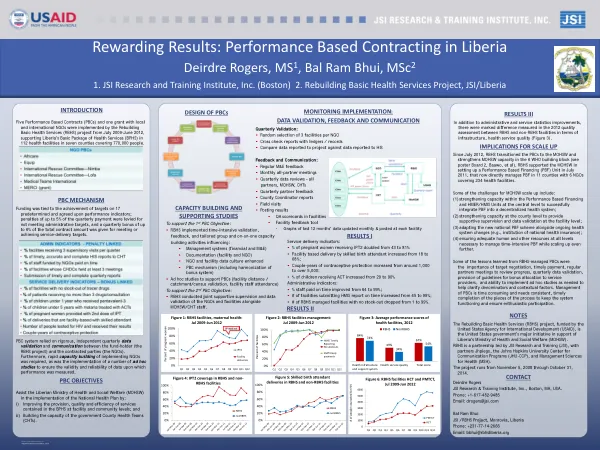
The project aimed to support Liberia's Basic Package of Health Services (BPHS) in 112 health facilities across seven counties, covering a population of 770,000 people. The project was led by JSI Research and Training Institute, Inc., in partnership with Jhpiego, the Johns Hopkins University Center for Communication Programs, and Management Sciences for Health. The RBHS project implemented five Performance-Based Contracts (PBCs) and one grant with local and international NGOs to improve the provision, quality, and efficiency of health services at facility and community levels. The project's objectives included improving management systems, documentation, and data culture, as well as building the capacity of the government County Health Teams (CHTs). The project also conducted joint supportive supervision and data validation of NGOs and facilities alongside the Ministry of Health and Social Welfare (MOHSW) and CHT staff. The PBC mechanism relied on rigorous, independent quarterly data validation and communication between the fund-holder (the RBHS project) and the contracted parties (the NGOs). Funding was tied to the achievement of targets on 17 predetermined and agreed-upon performance indicators, with penalties for not meeting administrative targets and bonuses for meeting or achieving service-delivery targets. The project also implemented a number of ad hoc studies to ensure the validity and reliability of data upon which performance was measured. The project achieved significant improvements in service delivery indicators, including a doubling of the percentage of pregnant women receiving IPT2 from 43 to 81%, an increase in facility-based delivery by skilled birth attendants from 18 to 68%, and an increase in couple-years of contraceptive protection from around 1,000 to over 5,000. Administrative indicators also showed improvements, including a 99% increase in the percentage of staff paid on time and a 99% increase in the number of facilities submitting HMIS reports on time. The project also made significant improvements in health infrastructure and support systems, with an average performance score of 74% in 2012, compared to 49% in 2009. The project's results were measured through regular monitoring and evaluation, including quarterly data validation, feedback, and communication. The project's success was attributed to the importance of target negotiation, timely payment, regular partner meetings, quarterly data reviews, and the provision of guidelines for bonus allocation to service providers. The RBHS project transitioned the PBCs to the MOHSW in July 2012 and strengthened MOHSW capacity in the six WHO building blocks. The project also supported the MOHSW in setting up a Performance-Based Financing (PBF) Unit in July 2011, which now directly manages PBF in 11 counties with six NGOs covering 234 health facilities. The project's lessons learned included the importance of target negotiation, timely payment, regular partner meetings, quarterly data reviews, and the provision of guidelines for bonus allocation to service providers.