U.S. NATIONAL RENEWABLE ENERGY LABORATORY
RE Data Explorer Is Expanding Public Access to High-Quality Data and Analytics
The Renewable Energy (RE) Data Explorer is a web platform developed by the National Renewable Energy Laboratory (NREL) in partnership with the U.S.
2023 · 2 pages
Sign in to readA free account is required to download.
Abstract
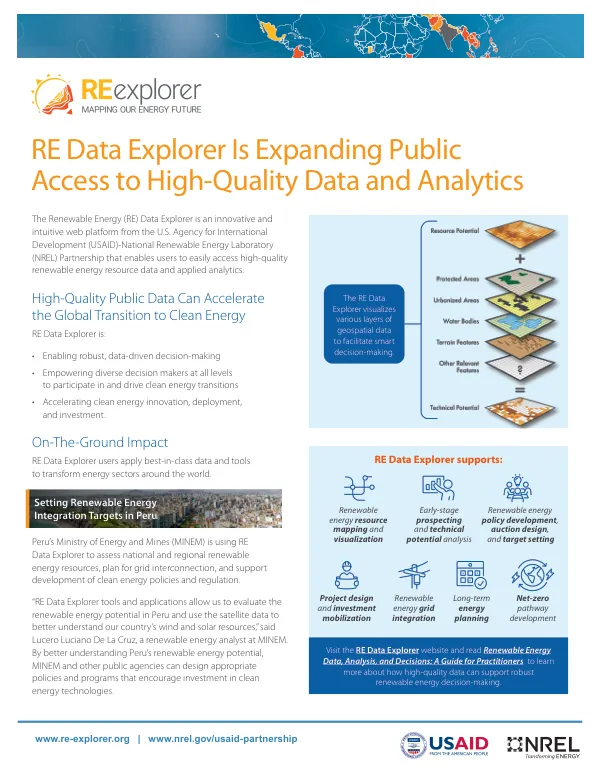
Agency for International Development (USAID). This platform enables users to access high-quality renewable energy resource data and applied analytics, facilitating robust, data-driven decision-making. The RE Data Explorer supports diverse decision makers at all levels in participating in and driving clean energy transitions. It accelerates clean energy innovation, deployment, and investment by providing users with best-in-class data and tools. The platform is expanding public access to high-quality data and analytics, enabling users to transform energy sectors around the world. Peru's Ministry of Energy and Mines (MINEM) is utilizing the RE Data Explorer to assess national and regional renewable energy resources, plan for grid interconnection, and support the development of clean energy policies and regulation. The platform's tools and applications allow MINEM to evaluate Peru's renewable energy potential and use satellite data to better understand the country's wind and solar resources. The RE Data Explorer supports various applications, including renewable energy grid integration, project design and investment mobilization, renewable energy resource mapping and visualization, early-stage prospecting and technical potential analysis, and renewable energy policy development, auction design, and target setting. The platform also facilitates long-term energy planning, net-zero pathway development, and setting renewable energy integration targets. In Kenya, the County Government of Kisumu launched a competitive tender for solar-powered microgrid development, with county planners applying the RE Data Explorer's technical potential estimator to propose solar PV capacities for hospitals, markets, and community-centered projects. More than 1,800 users in 88 countries have provided feedback on how they are using the RE Data Explorer to inform project development and investment decisions, ranging from utility-scale solar to remote rural microgrids. In Vietnam, NREL researchers, in partnership with USAID's Vietnam Low Emission Energy Program (V-LEEP), used the RE Data Explorer's high-fidelity solar resource data to build detailed power system models that enabled decision makers to identify the type and size of variable renewable energy generation capacity needed to meet their energy transition goals. The platform's high-fidelity solar resource data has also been used to train a machine learning algorithm that predicts solar irradiance for different regions in Australia. The RE Data Explorer has been used in various applications, including launching competitive tenders for renewable microgrids in Kenya, modeling renewable power systems in Vietnam, deploying utility-scale solar in locations around the world, and training recurrent neural networks and artificial intelligence models to predict solar power production.