USAID DEC
Re-envisioning the Champion Communities Approach to Better Serve Urban Populations in the Democratic Republic of the Congo
Sign inCHEMONICS
Re-envisioning the Champion Communities Approach to Better Serve Urban Populations in the Democratic Republic of the Congo
The Champion Communities Approach to Better Serve Urban Populations in the Democratic Republic of the Congo is a community mobilization strategy implemented by USAID's Projet Intégré de VIH/SIDA au Congo (ProVIC) to reduce the risk of HIV transmission among key populations in urban areas.
2014 · 1 pages
Sign in to readA free account is required to download.
Abstract
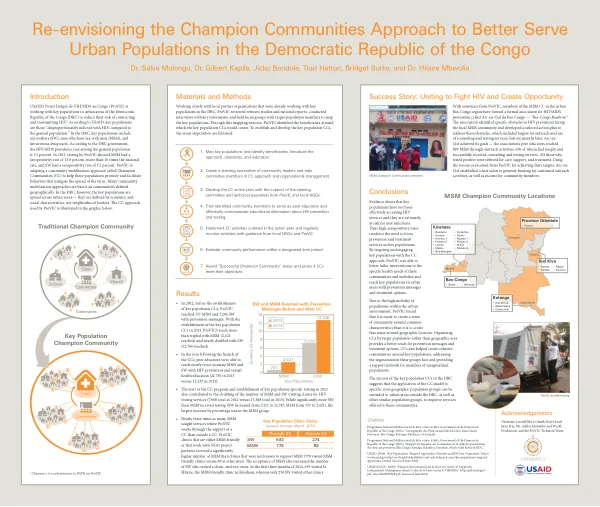
Key populations in the DRC include sex workers (SW), men who have sex with men (MSM), and intravenous drug users. According to ProVIC, these populations are disproportionately infected with HIV compared to the general population, with an HIV/AIDS prevalence rate of 1.1 percent among the general population, compared to 13.8 percent among MSM and 7.2 percent among SW. ProVIC adapted the Champion Communities approach to address the unique needs of these populations, which are spread across urban areas and defined by economic and social characteristics rather than geographic location. The approach involves seven steps: mapping key populations and identifying beneficiaries, creating a steering committee of community leaders, developing a community action plan, training peer educators, implementing community activities, evaluating community performance, and awarding "Successful Champion Community" status to communities that meet their objectives. The Champion Communities approach has shown significant success in reaching key populations with prevention messages and treatment options. In 2012, ProVIC reached 757 MSM and 7,206 SW with prevention messages, but with the establishment of key population Champion Communities in 2013, ProVIC's reach more than tripled, with 2,621 MSM and 12,746 SW reached. Peer educators were able to reach nearly twice as many MSM and SW with HIV prevention and sexual health education in 2013 compared to 2012, and the number of MSM and SW visiting clinics for HIV testing services doubled in 2013. The success of the Champion Communities approach in the DRC suggests that it can be extended to urban areas outside the DRC and other similar population groups to improve services offered to these communities. The approach has also helped create cohesive communities around key populations, addressing the stigmatization these groups face and providing a support network for members of marginalized populations. In the Bas-Congo region, members of the MSM Champion Community formed a formal association for HIV/AIDS prevention called Arc-en-Ciel du Bas-Congo, which identified specific obstacles to HIV prevention facing the local MSM community and developed a tailored action plan to address these obstacles. The association's peer educators reached 899 MSM through outreach activities, 650 of whom had sought and successfully received counseling and testing services. The Champion Communities approach has been successful in reducing the risk of HIV transmission among key populations in the DRC, and its application can be extended to other urban areas and population groups to improve services offered to these communities. The approach has also helped create cohesive communities around key populations, addressing the stigmatization these groups face and providing a support network for members of marginalized populations.