RTI INTERNATIONAL
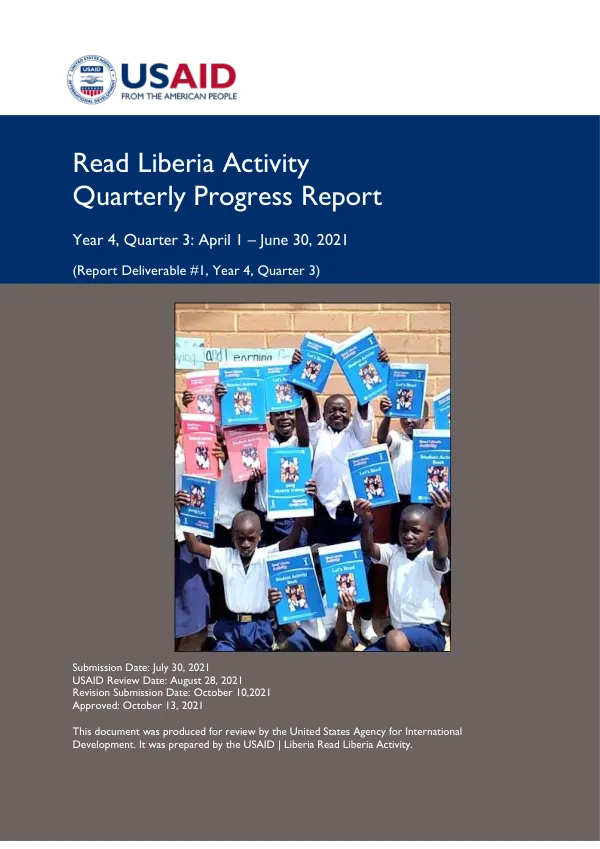
Read Liberia Activity Quarterly Progress Report
The Read Liberia Activity is a USAID-funded program aimed at improving early grade reading outcomes in Liberia.
2021 · 63 pages
Sign in to readA free account is required to download.
Abstract
The program began on September 25, 2017, and is set to conclude on September 24, 2022. The program is implemented by RTI International, with the Ministry of Education, Government of Liberia, serving as a major counterpart organization. The program focuses on six counties: Bong, Grand Bassa, Lofa, Margibi, Montserrado, and Nimba. The program's primary objective is to improve reading instruction in early grade classrooms, with a focus on increasing government commitment to and support of evidence-based reading instruction. Implementation progress is reported in four key areas: IR 1, IR 2, IR 3, and IR 4. IR 1 focuses on increasing government commitment to and support of evidence-based reading instruction, with a target of 80% of schools implementing evidence-based reading instruction by the end of Year 4. As of the reporting quarter, 75% of schools have implemented evidence-based reading instruction. IR 2 focuses on improving EGR classroom instruction, with a target of 90% of teachers using evidence-based reading instruction methods by the end of Year 4. As of the reporting quarter, 85% of teachers have adopted evidence-based reading instruction methods. IR 3 focuses on improving service delivery systems in EGR, with a target of 90% of schools having functional service delivery systems by the end of Year 4. As of the reporting quarter, 80% of schools have functional service delivery systems. IR 4 focuses on increasing parent, community, and private support for EGR, with a target of 80% of parents and community members supporting EGR by the end of Year 4. As of the reporting quarter, 75% of parents and community members support EGR. The program has achieved several successes, including the training of over 2,000 teachers and the establishment of 15 demonstration plots to showcase the effectiveness of evidence-based reading instruction. However, the program has also faced several challenges, including the COVID-19 pandemic, which has disrupted program activities. The program has implemented several mitigation strategies to address these challenges, including the use of virtual training sessions and the provision of additional support to schools. The program has also updated its Annual Monitoring, Evaluation, and Learning Plan (AMELP) to reflect changes in the program's implementation. The program has also made progress in integrating cross-cutting issues and USAID forward priorities, including gender equality, female empowerment, and social inclusion. The program has also established partnerships with several private sector partners, including OSIWA and PIDS. The program has also made progress in stakeholder participation and involvement, with regular meetings with partners and stakeholders. The program has also established a coaching transition log to track the transition of coaching responsibilities from one staff member to another. The program has also made progress in management and administrative issues, including the hiring of new staff and the resignation of several staff members. The program has also updated its list of attachments, including a progress summary, a success story, and a Liberia Ministry of Education/County structure. The program has also made progress in lessons learned, including the importance of adapting to changing circumstances and the need for continued support from stakeholders. The program has also identified several areas for improvement, including the need for more effective communication with stakeholders and the need for more robust monitoring and evaluation systems. The program has planned several activities for the next quarter, including the establishment of a new coaching team and the implementation of a new monitoring and evaluation system. The program has also identified several upcoming events, including a national reading conference and a meeting with the Ministry of Education. The program has also addressed several comments from the last quarterly report, including the need for more effective communication with stakeholders and the need for more robust monitoring and evaluation systems. The program has also updated its list of attachments, including a progress summary, a success story, and a Liberia Ministry of Education/County structure. Overall, the Read Liberia Activity has made significant progress in improving early grade reading outcomes in Liberia. However, the program continues to face several challenges, including the COVID-19 pandemic and the need for continued support from stakeholders.
Related documents