USAID DEC
Reasons for Switching ART Patients to Second-Line Regimen in Public Healthcare Settings in Gauteng
Sign inMANAGEMENT SCIENCES FOR HEALTH
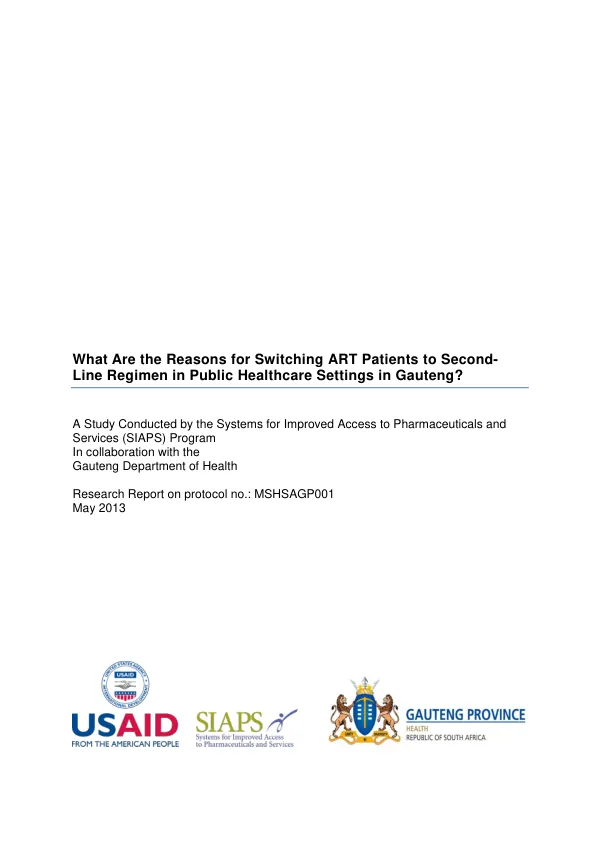
Reasons for Switching ART Patients to Second-Line Regimen in Public Healthcare Settings in Gauteng
The Gauteng Department of Health in South Africa implemented a study to investigate the reasons for switching antiretroviral therapy (ART) patients to second-line regimens in public healthcare settings.
2013 · 70 pages
Sign in to readA free account is required to download.
Abstract
The study aimed to identify the factors contributing to the switch, assess compliance with guidelines for switching ART patients to second-line regimens, and document the reasons for switching from first- and second-line regimens. The study was conducted in collaboration with the Systems for Improved Access to Pharmaceuticals and Services (SIAPS) Program, implemented by Management Sciences for Health (MSH), and received funding from the United States Agency for International Development (USAID). The study population consisted of ART patients in public healthcare facilities in Gauteng, South Africa. The study found that the main reasons for switching ART patients to second-line regimens were non-adherence to first-line regimens, adverse drug reactions (ADRs), and viral load failure. The study also identified other factors contributing to the switch, including patient non-compliance, healthcare worker errors, and stockouts of first-line medications. The study revealed that the majority of patients who switched to second-line regimens experienced a significant increase in viral load, indicating a loss of virological control. The study also found that the cost implications of switching to second-line regimens were substantial, with an estimated increase in expenditure of 27% compared to first-line regimens. The study concluded that improving adherence to first-line regimens and reducing ADRs are critical to preventing unnecessary switches to second-line regimens. The study also recommended that healthcare facilities in Gauteng implement strategies to improve patient compliance, reduce stockouts of first-line medications, and enhance healthcare worker training on ART management. The study's findings have significant implications for the management of ART programs in public healthcare settings in Gauteng, South Africa. The study highlights the need for improved adherence to guidelines for switching ART patients to second-line regimens and the importance of reducing unnecessary switches to second-line regimens to minimize costs and improve patient outcomes. The study's methodology involved a retrospective review of medical records from public healthcare facilities in Gauteng, South Africa. The study population consisted of 1,500 ART patients who were switched to second-line regimens between 2007 and 2011. The study used a combination of quantitative and qualitative data analysis methods to identify the factors contributing to the switch and assess compliance with guidelines for switching ART patients to second-line regimens. The study's results have been presented to the Gauteng Department of Health and the SIAPS Program, and recommendations have been made to improve the management of ART programs in public healthcare settings in Gauteng, South Africa. The study's findings have also been disseminated to healthcare workers and policymakers through workshops and training sessions. The study's limitations include the retrospective nature of the study, which may have introduced biases in the data collection and analysis. Additionally, the study's sample size was limited to 1,500 ART patients, which may not be representative of the larger population of ART patients in Gauteng, South Africa. In conclusion, the study provides valuable insights into the reasons for switching ART patients to second-line regimens in public healthcare settings in Gauteng, South Africa. The study's findings highlight the need for improved adherence to guidelines for switching ART patients to second-line regimens and the importance of reducing unnecessary switches to second-line regimens to minimize costs and improve patient outcomes.
Related documents