USAID DEC
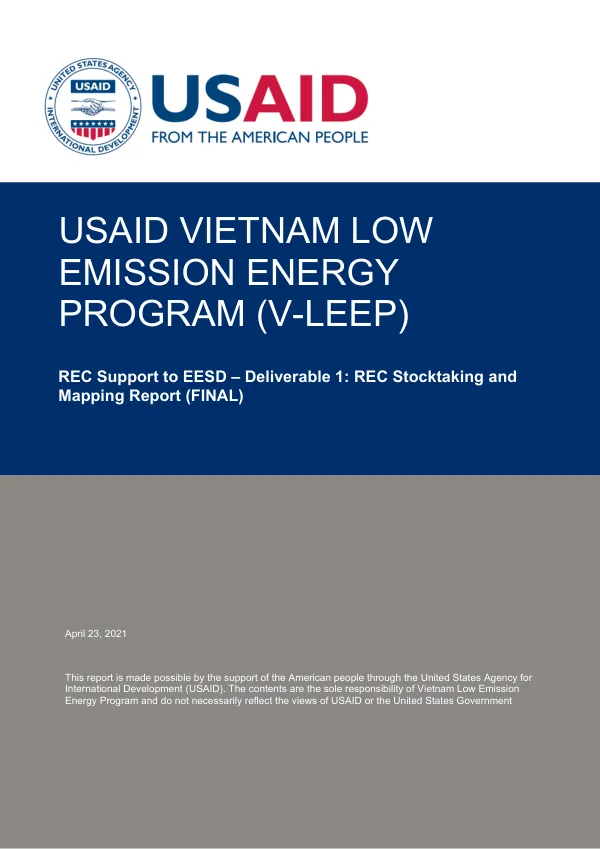
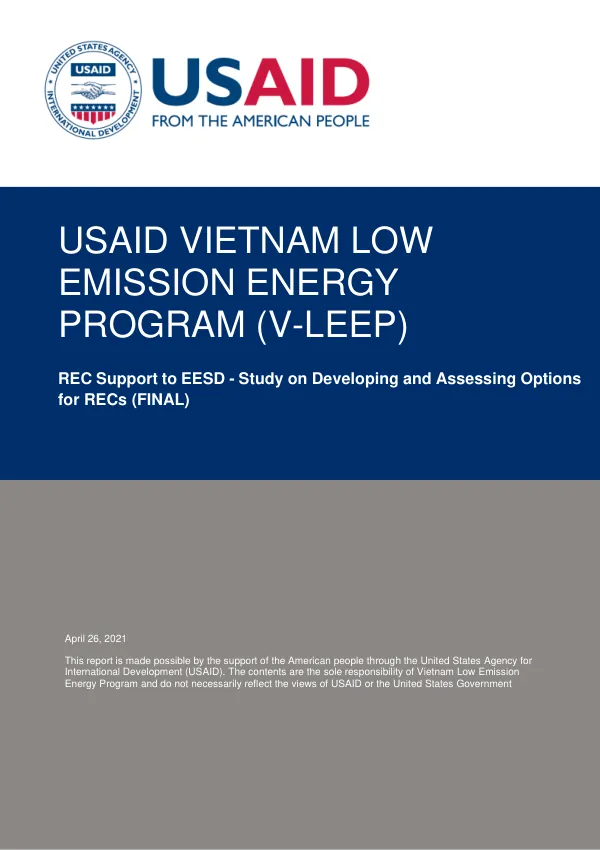
REC Support to EESD - Study on Developing and Assessing Options for RECs (FINAL)
The Vietnam Low Emission Energy Program (V-LEEP) initiated a study on developing and assessing options for Renewable Energy Certificates (RECs) in Vietnam.
2021 · 61 pages
Sign in to readA free account is required to download.
Abstract
The study aimed to identify suitable REC tracking and management systems for the country. The REC system is a mechanism to promote the development and use of renewable energy sources. The study began by assessing consumer requirements and the current enabling environment in Vietnam. Key institutional players, including the Ministry of Industry and Trade, the Ministry of Natural Resources and Environment, and the Electricity of Vietnam (EVN), were identified. The study also reviewed existing settlement processes for quantity/time/date/place stamping in Vietnam against international practices and consumer requirements. The assessment revealed that Vietnam's current enabling environment is not fully aligned with international leading practices. The study proposed three options for REC tracking and management systems in Vietnam: a domestic REC system, engagement with existing international REC market operators, and hybrid approaches. Each option was evaluated based on technical, legal, and institutional requirements. The domestic REC system involves creating a domestic registry for RECs, which would require establishing a legal and institutional framework. The study identified necessary legal, institutional, and technical requirements for creating a domestic REC registry in Vietnam. These requirements include developing a REC policy, establishing a registry, and implementing a tracking and verification system. Engagement with existing international REC market operators involves partnering with international REC registries, such as the I-REC Standard and the TIGR system. The study evaluated the technical, legal, and institutional requirements for using international REC registries in Vietnam. This option would require establishing linkages with the DPPA Pilot Program and considering the pros and cons of using existing REC systems. Hybrid approaches involve combining domestic and international REC systems. The study proposed two hybrid approaches: a domestic-TIGRs hybrid system and a domestic-I-REC hybrid system. Each hybrid approach was evaluated based on technical, legal, and institutional requirements. The study also examined the current legal, institutional, and technical environment for RECs in Vietnam. The analysis revealed that the current environment is not fully aligned with international leading practices. The study proposed necessary legal, institutional, and technical requirements for each REC management option in Vietnam. A comparative assessment of REC tracking and management options for Vietnam was conducted. The study evaluated the practical options to apply RECs in Vietnam and compared the REC options in Vietnam. The comparison revealed that the international registry option has a lower cost-benefit ratio compared to the hybrid registry option. The study concluded that the domestic REC system, engagement with existing international REC market operators, and hybrid approaches are viable options for REC tracking and management systems in Vietnam. The implementation of a REC system would require establishing a legal and institutional framework, developing a REC policy, and implementing a tracking and verification system. The study provided recommendations for the implementation of a REC system in Vietnam.