DELOITTE CONSULTING, LLP
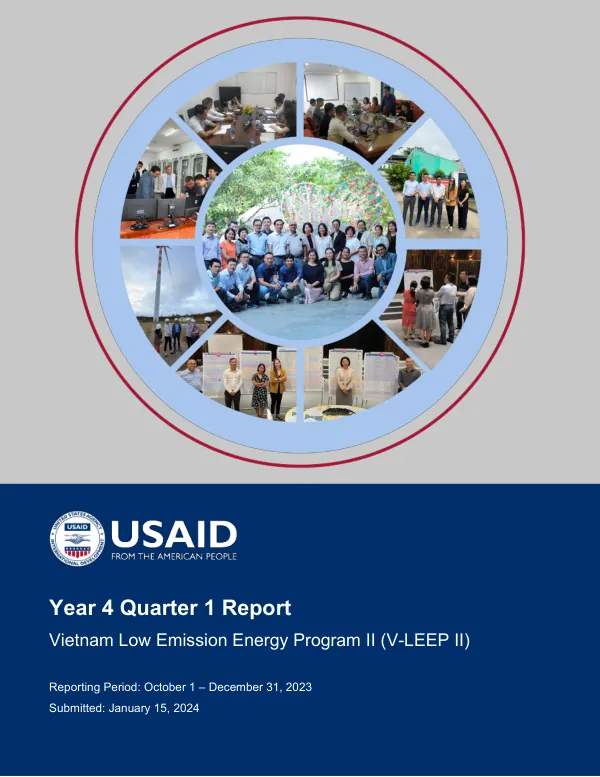
Year 4 Quarter 1 Report: Vietnam Low Emission Energy Program II (V-LEEP II)
The Vietnam Low Emission Energy Program II (V-LEEP II) aims to advance Vietnam's transition to a clean, secure, and market-based energy sector.
2024 · 50 pages
Sign in to readA free account is required to download.
Abstract
The program is aligned with the Government of Vietnam's (GVN) energy development goals and the Nationally Determined Contribution (NDC) under the Paris Agreement. V-LEEP II is a flagship clean energy program of USAID/Vietnam, which strives to support an "open, prosperous, and secure Vietnam that is effective and inclusive in tackling its own development challenges." The program has three main objectives: (1) Increased deployment of advanced energy systems, (2) Improved energy sector performance, and (3) Increased energy sector competition. To achieve these objectives, V-LEEP II focuses on technical areas such as Electricity and Renewable Energy Authority (EREA) tasks, USAID tasks, Electricity Regulatory Authority of Vietnam (ERAV) tasks, Energy Efficiency and Sustainable Development Department (EESD) tasks, and Oil, Gas and Coal Department (OGCD) tasks. In Quarter 1 of Year 4, significant progress was made in these technical areas. EREA tasks included the development of a comprehensive energy master plan, which aims to increase the share of renewable energy in the energy mix. USAID tasks focused on supporting the development of a power development plan, which aims to ensure a reliable and efficient energy supply. ERAV tasks involved the implementation of a demand-side management program, which aims to reduce energy consumption and promote energy efficiency. EESD tasks included the development of a energy efficiency and sustainable development plan, which aims to promote energy efficiency and sustainable development practices in the energy sector. OGCD tasks focused on supporting the development of a liquefied natural gas (LNG) import plan, which aims to ensure a reliable and efficient energy supply. In addition to technical progress, V-LEEP II also made significant progress in operations, compliance, and staffing. The program implemented a new operations manual, which aims to improve the efficiency and effectiveness of program operations. The program also made significant progress in subcontracting, with several new subcontractors engaged to support program activities. The program also made significant progress in cross-cutting enabling areas, including grants, gender and development, private sector engagement, and communications and outreach. The program implemented a new grants program, which aims to support the development of clean energy projects in Vietnam. The program also made significant progress in promoting gender and development, with several new initiatives launched to support the participation of women in the energy sector. In terms of monitoring, evaluation, and learning (MEL), V-LEEP II made significant progress in tracking progress towards approved MEL indicators. The program also implemented several Collaborating, Learning and Adapting (CLA) activities, which aim to promote learning and adaptation in the program. Overall, V-LEEP II made significant progress in Quarter 1 of Year 4, with significant achievements in technical areas, operations, compliance, and staffing. The program continues to make progress towards its objectives, and is well-positioned to achieve its goals in the coming quarters.