USAID DEC
Recent developments in phase change materials for energy storage applications: A review
Sign inARIZONA STATE UNIVERSITY
Recent developments in phase change materials for energy storage applications: A review
The increasing demand-supply energy gap due to rapid urbanization, labor productivity, consumerism, and depletion of fossil fuel resources necessitates the development of technologies with renewable energy sources.
2019 · 33 pages
Sign in to readA free account is required to download.
Abstract
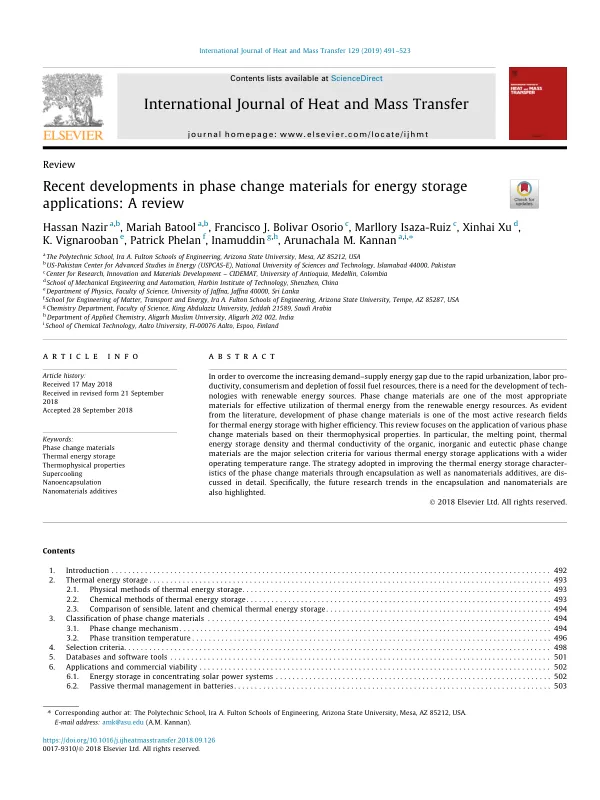
Phase change materials (PCMs) are one of the most suitable materials for effective utilization of thermal energy from renewable energy resources. PCMs are widely used in various thermal energy storage applications, including energy storage in concentrating solar power systems, passive thermal management in batteries, thermal storage in buildings, solar water heating, cold storage, and photovoltaic-thermal systems. The classification of PCMs is based on their thermophysical properties, including melting point, thermal energy storage density, and thermal conductivity. Organic, inorganic, and eutectic PCMs are the primary categories, with the selection criteria for various thermal energy storage applications including a wider operating temperature range. The strategy adopted in improving the thermal energy storage characteristics of PCMs through encapsulation and nanomaterials additives is discussed in detail. Encapsulation of PCMs involves various methods, including microencapsulation, nanoencapsulation, and macroencapsulation. The working principle of encapsulated PCMs involves the use of a shell material to encapsulate the PCM, which enhances its thermal energy storage capacity and stability. Performance enhancement of PCMs can be achieved through the use of nanomaterials additives, which improve their thermal conductivity and stability. Nanomaterials additives, such as carbon nanotubes and graphene, are used to enhance the thermal performance of PCMs. Other thermal performance enhancement techniques, including the use of phase change composites and hybrid PCMs, are also discussed. A comparison of PCMs and an overview of technologies are provided, highlighting the advantages and limitations of each technology. The increasing demand for thermal energy storage solutions has led to the development of various technologies, including PCMs, phase change composites, and hybrid PCMs. The use of PCMs in various applications, including energy storage in concentrating solar power systems, passive thermal management in batteries, and thermal storage in buildings, is discussed in detail. The future trends in PCM research, including the use of nanomaterials additives and encapsulation techniques, are also highlighted. The development of PCMs with improved thermal energy storage capacity and stability is crucial for the widespread adoption of thermal energy storage technologies. The use of nanomaterials additives and encapsulation techniques can enhance the thermal performance of PCMs, making them more suitable for various applications. The increasing demand for thermal energy storage solutions and the development of new technologies will continue to drive research in this field. The thermal energy storage capacity of PCMs can be improved through the use of phase change composites and hybrid PCMs. These materials combine the benefits of PCMs with other thermal energy storage materials, such as phase change composites and hybrid PCMs. The use of phase change composites and hybrid PCMs can enhance the thermal energy storage capacity and stability of PCMs, making them more suitable for various applications.