FUTURES GROUP INTERNATIONAL, LLC
Reducing MDG Costs through Family Planning in Francophone West Africa
The Millennium Development Goals (MDGs) are eight timebound global development goals agreed to by member states of the United Nations and international development institutions.
2011 · 2 pages
Sign in to readA free account is required to download.
Abstract
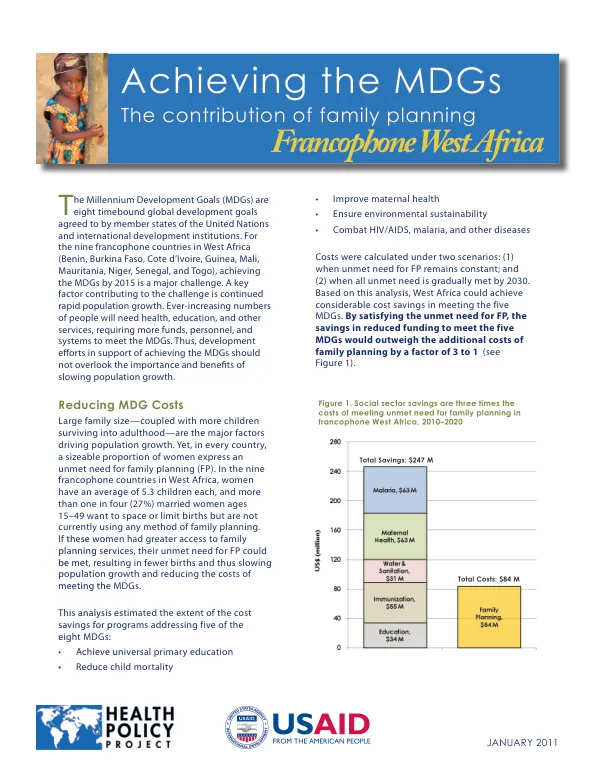
For the nine francophone countries in West Africa, achieving the MDGs by 2015 is a major challenge. A key factor contributing to the challenge is continued rapid population growth. Ever-increasing numbers of people will need health, education, and other services, requiring more funds, personnel, and systems to meet the MDGs. Thus, development efforts in support of achieving the MDGs should not overlook the importance and benefits of slowing population growth. Reducing MDG costs is crucial, and large family size, coupled with more children surviving into adulthood, are the major factors driving population growth. Yet, in every country, a sizeable proportion of women express an unmet need for family planning (FP). In the nine francophone countries in West Africa, women have an average of 5.3 children each, and more than one in four (27%) married women ages 15-49 want to space or limit births but are not currently using any method of family planning. If these women had greater access to family planning services, their unmet need for FP could be met, resulting in fewer births and thus slowing population growth and reducing the costs of meeting the MDGs. This analysis estimated the extent of the cost savings for programs addressing five of the eight MDGs: achieving universal primary education, reducing child mortality, improving maternal health, ensuring environmental sustainability, and combating HIV/AIDS, malaria, and other diseases. Costs were calculated under two scenarios: when unmet need for FP remains constant, and when all unmet need is gradually met by 2030. Based on this analysis, West Africa could achieve considerable cost savings in meeting the five MDGs. By satisfying the unmet need for FP, the savings in reduced funding to meet the five MDGs would outweigh the additional costs of family planning by a factor of 3 to 1. The cost savings in meeting the MDGs are substantial. In the education sector, satisfying unmet need for family planning would result in fewer children requiring education, and as a result, the costs for universal primary education would be lower. The cumulative cost savings to the education sector from satisfying unmet need amount to US$34 million between 2010 and 2020. In the maternal and child health sector, addressing unmet need for FP in West Africa could be expected to save US$182 million in maternal and child health costs over the next decade. Furthermore, this investment in family planning would avert an estimated 7,389 maternal deaths and 557,627 child deaths between 2010 and 2020. Providing family planning services to families wishing to space and limit their births can reduce the costs of meeting the MDGs and directly contribute to fewer maternal and child deaths. The analysis shows that addressing unmet need for FP in West Africa could be expected to save US$247 million in costs over the next decade, with a total savings of US$182 million in maternal and child health costs and US$34 million in education costs. This investment in family planning would have a significant impact on the lives of women and children in West Africa, reducing the number of maternal and child deaths and improving overall health outcomes.