USAID DEC
Associations between parents' exposure to a multisectoral programme and infant and young child feeding practices in Nepal
Sign inCARE
Associations between parents' exposure to a multisectoral programme and infant and young child feeding practices in Nepal
A family approach for nutrition is widely agreed upon as a critical window of opportunity for interventions, precisely because nutritional well-being at this critical time will impact the child for the rest of their life.
2021 · 12 pages
Sign in to readA free account is required to download.
Abstract
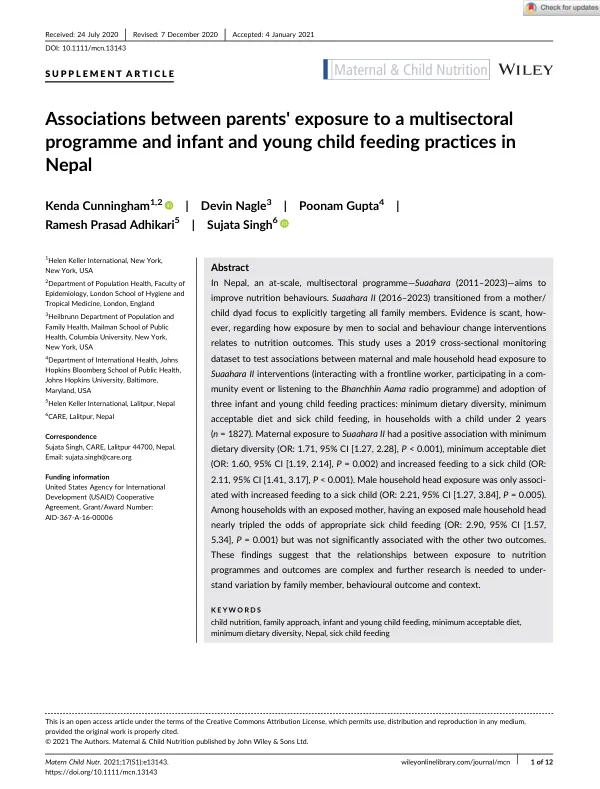
Insufficient nutrition during this period can lead to a plethora of health and development risks, including stunting, wasting, brain underdevelopment, and death. Improving maternal and child health and nutrition (MCHN) outcomes in low- and middle-income countries is a high priority of governments and development partners alike. Research on family approaches to MCHN interventions is emerging, dominated by qualitative studies to date. Evidence suggests that breastfeeding interventions that target the father improve breastfeeding initiation, duration, and exclusivity rates in a variety of settings. Training fathers to be more involved and supportive of continued breastfeeding was found to be associated with higher breastfeeding and exclusive breastfeeding rates. Fewer studies have been done on complementary feeding outcomes, but a cross-sectional study in Ethiopia found positive associations between fathers' knowledge and attitudes and child dietary diversity. Nepal has made significant progress in reducing maternal and child mortality and improving health outcomes, including reducing maternal and child undernutrition. However, according to Nepal's 2016 Demographic and Health Survey, among children 6–23 months of age, only 47% are fed a diet of foods from at least four of seven food groups that meets the cut-off for minimum dietary diversity and only 37% are fed a minimum acceptable diet. The Government of Nepal implements a Multi-Sectoral Nutrition Plan (MSNP), now in its second phase, prioritizing the reduction of malnutrition. Suaahara II, a 7-year (2016–2023) USAID-funded multisectoral nutrition programme, supports Nepal's MSNP and operates in 42 districts of Nepal to reach over 1 million households in the 1000-day period. The programme's overall aim is to improve the nutritional status of pregnant and lactating women and children under 2 years via interventions spanning maternal, newborn, and child nutrition; health and family planning services; water, sanitation, and hygiene (WASH); homestead food production and agricultural marketing; and nutrition governance. A cross-sectional monitoring dataset from 2019 was used to test associations between maternal and male household head exposure to Suaahara II interventions and adoption of three infant and young child feeding practices: minimum dietary diversity, minimum acceptable diet, and sick child feeding. Maternal exposure to Suaahara II had a positive association with minimum dietary diversity, minimum acceptable diet, and increased feeding to a sick child. Male household head exposure was only associated with increased feeding to a sick child. Among households with an exposed mother, having an exposed male household head nearly tripled the odds of appropriate sick child feeding but was not significantly associated with the other two outcomes.
Related documents
Documents in this collection
 2023
2023USAID DEC
Text messages to improve child diets: Formative research findings and protocol of a randomised controlled trial in Nepal
Open record 2017
2017USAID DEC