USAID
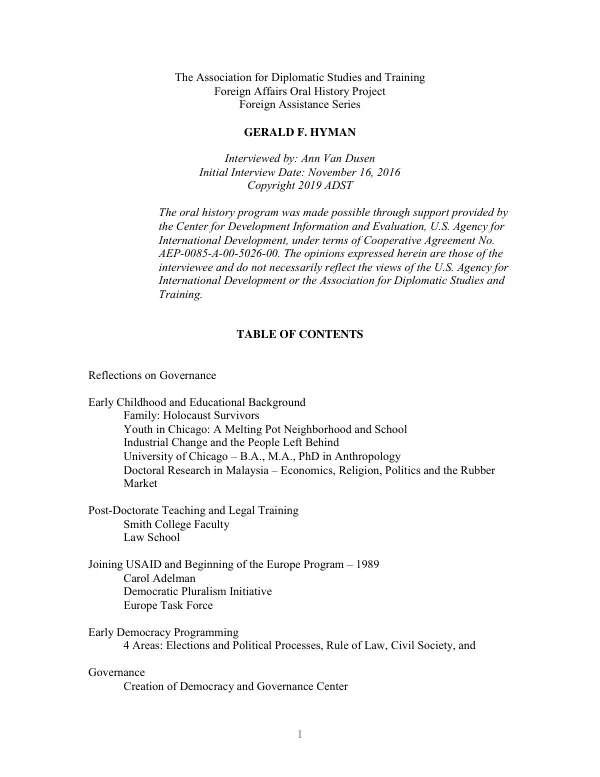
Reflections on Governance: An Interview with Gerald F. Hyman
The concept of governance has been a long-standing concern in international development, particularly in the context of post-conflict or post-transition countries.
2019 · 73 pages
Sign in to readA free account is required to download.
Abstract
Gerald F. Hyman, a seasoned diplomat and expert in governance, has dedicated a significant portion of his career to addressing this issue. Hyman's experience in the field of governance began in the late 1980s, when he joined the United States Agency for International Development (USAID) and became involved in the Europe Program. During his tenure at USAID, Hyman recognized the importance of governance in the consolidation of democracy. He noted that the performance failures of new democratic governments were a significant challenge in the transition process. Hyman's work in this area was ahead of its time, as the focus on governance was often overshadowed by more visible aspects of democracy programming, such as elections and human rights. Hyman's experience in governance was shaped by his work at the Center for Strategic and International Studies (CSIS), where he led a governance program for nine years. However, the program faced financial challenges, and Hyman was forced to seek alternative funding arrangements. He eventually joined the Democracy and Governance Center, where he continued to work on governance issues. Hyman's approach to governance emphasized the need to address the entrenched elites and corrupt practices that often hindered democratic transitions. He recognized that this was a difficult problem to solve, particularly in countries with entrenched nepotism and corruption. Hyman's work in this area was characterized by a focus on building mechanisms to support the field and promoting a culture of governance within the development community. One of the key challenges Hyman faced in his work on governance was the lack of attention and resources dedicated to this area. He noted that the democracy and governance community often prioritized more visible aspects of democracy programming, such as elections and human rights. Hyman's experience highlighted the need for a more nuanced approach to governance, one that recognized the importance of performance and accountability in democratic transitions. In his work on governance, Hyman drew on his experience in various countries, including Bosnia, Romania, and South Sudan. He recognized the importance of context in governance programming and emphasized the need for a tailored approach that took into account the specific needs and challenges of each country. Hyman's work in this area was characterized by a focus on building capacity and promoting a culture of governance within the development community. Overall, Gerald F. Hyman's experience in governance highlights the importance of this issue in international development. His work emphasizes the need for a nuanced approach to governance, one that recognizes the importance of performance and accountability in democratic transitions. Hyman's experience also underscores the challenges of addressing entrenched elites and corrupt practices, and the need for a tailored approach that takes into account the specific needs and challenges of each country.
Related documents