DEVTECH SYSTEMS, INC.
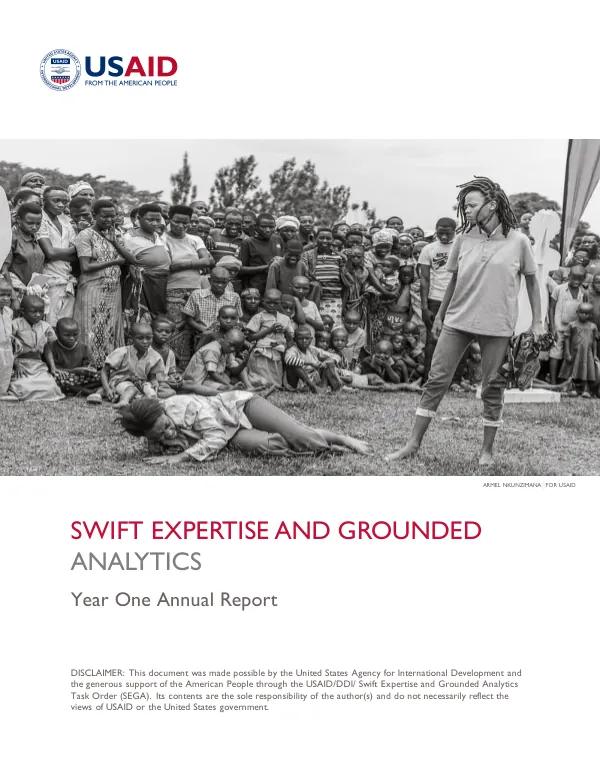
USAID SEGA Year 1 Annual Report
The Democratic Openings Methodology was developed by DevTech to identify countries experiencing or likely to experience democratic openings.
2022 · 13 pages
Sign in to readA free account is required to download.
Abstract
The methodology employs a two-step, mixed methods approach, combining quantitative and qualitative analyses. Quantitative data from the University of Gothenburg's Variety of Democracy (V-Dem) Indices is used to identify potential democratic openings, while a qualitative filter is applied to decide the best candidates for assistance. The methodology considers six key factors that affect a democratic opening, including per capita income, government performance, and ethnic and religious divisions. Additionally, four less-critical factors are considered, including the caliber of leadership and the size and autonomy of the middle class. The methodology was tested by conducting both qualitative and quantitative analysis to produce a short, annotated list of possible democratic openings. The SEGA team is currently finalizing the inaugural Democratic Openings List Report, which is scheduled to be presented to the DRG Center in the first quarter of Year 2. A comprehensive research study of the digital democracy and digital repression landscape was conducted in 40 USAID countries. The study analyzed countries' legal and regulatory environments, institutional resiliencies to digital repression, and the capacity of the technology sector to embed human rights and democratic values. The study also examined existing multi-stakeholder networks and partnerships that could be strengthened and expanded to improve the digital space for democracy. The Digital Democracy Analysis aimed to inform the DRG Center's emerging digital democracy strategy, which outlines a vision for development programming in a rapidly changing digital world. The strategy employs a 'whole of society' approach, engaging governments, technology companies, universities, civil society, and the general public in efforts to align the development, use, deployment, and governance of technology with international human rights norms and democratic values. The study's findings will be used to establish a field guide, including a new robust set of tools, to build, supplement, and expand USAID's existing technical expertise and skills to effectively program in the area of digital democracy. The field guide will provide a comprehensive framework for USAID to design and implement programs that promote digital democracy and prevent digital repression. The SEGA Year 1 Annual Report highlights the successes and lessons learned from the implementation of the Democratic Openings Methodology and the Digital Democracy Analysis. The report provides a summary of the virtual and in-country analyses, assessments, and advisory services implemented during the period under review, as well as a summary of Grants Under Contracts (GUCs) issued during the period under review. The report also identifies challenges and obstacles that had to be overcome and highlights lessons learned and successes to be highlighted. The report serves as a key document for the SEGA Activity, providing a comprehensive overview of the work implemented during the first year. The report will be used to inform future programming and to identify areas for improvement.
Related documents