GOVERNMENT OF THE ISLAMIC REPUBLIC OF AFGHANISTAN
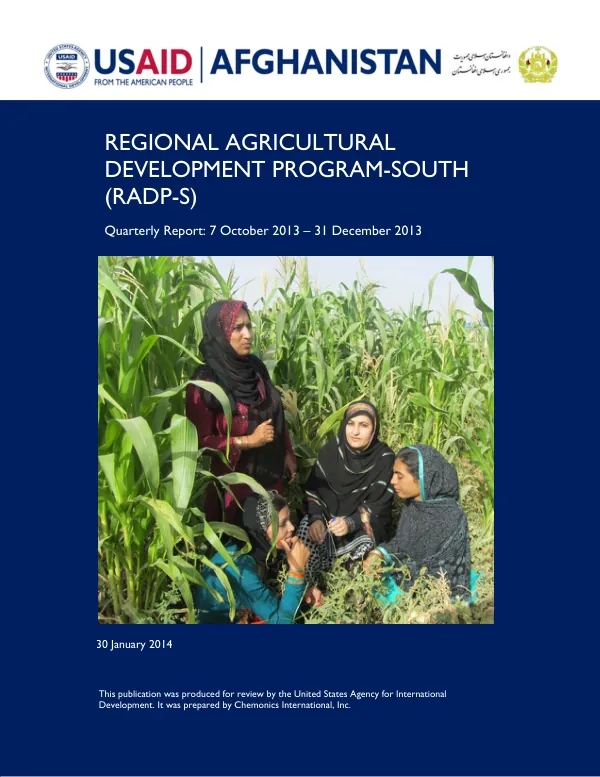
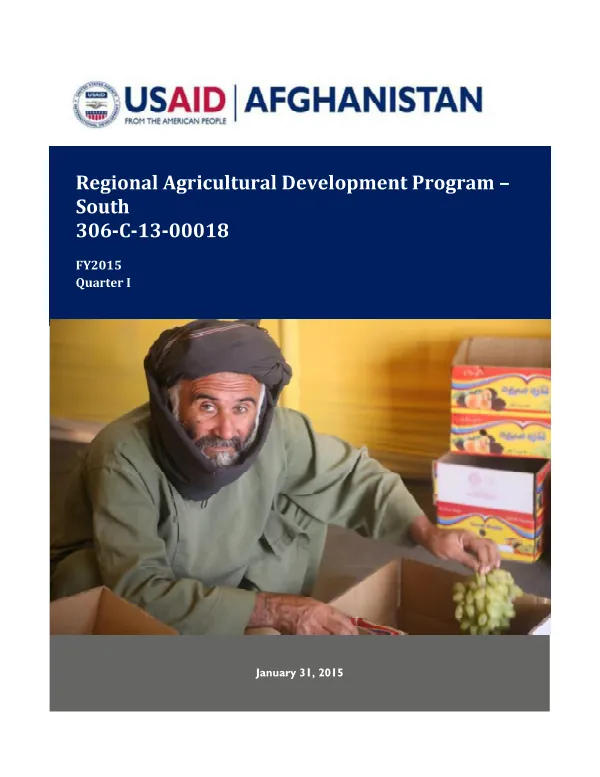
Regional Agricultural Development Program-South (RADP-S) Quarterly Report FY2015 Q1
The Regional Agricultural Development Program-South (RADP-S) aims to improve food and economic security for rural Afghans in the provinces of Kandahar, Helmand, Zabul, and Uruzgan.
2015 · 34 pages
Sign in to readA free account is required to download.
Abstract
To achieve this goal, RADP-S focuses on improving the productivity and profitability of the wheat, high value crops, and livestock value chains, while addressing policy, legal, and regulatory constraints affecting value chain development. This agricultural development program supports the consolidation of licit economies to fuel sustainable long-term economic growth, including providing alternatives to poppy cultivation. RADP-S implementation approach dovetails with Afghan and U.S. government strategies in its focus on advancing food security, regenerating agribusiness, and increasing agriculture sector jobs and incomes. The program aims to strengthen the capacity of producers, associations, traders, and agribusinesses to respond to market demands; facilitate lasting market linkages between value chain actors; and support an enabling environment that allows the private sector to thrive. RADP-S places the Afghan private sector at the forefront of implementation and facilitation, laying the foundation for greater and more socially inclusive growth in the agricultural economy. In FY 2015 Q1, RADP-S continued to implement activities under all project components with notable accomplishments in productivity and production, value chain facilitation, and gender integration activities. Under the productivity and production unit, RADP-S carried out its comprehensive training program, utilizing an active training model that combines formal classroom training with practical hands-on experience at demonstration farms. RADP-S built the capacity of master trainers to transfer knowledge to lead farmers and other beneficiary farmers. In November, RADP-S conducted a two-week intensive Training of Trainers (ToT) course for 50 master trainers from all four provinces at the AMTEX Technical Training Facility and Demonstration Farm. RADP-S master trainers conducted trainings throughout the quarter to lead farmers and beneficiary farmers in all 15 target districts across Kandahar, Helmand, Uruzgan, and Zabul. Trainings covered both wheat and high value crop (HVC) topics such as orchard water management, greenhouse establishment, wheat plant nutrition, vegetable plant nutrition, vineyard weed control, wheat water management, and vineyard establishment. To support the project objective of increasing the sales value of target commodities, RADP-S worked to build the capacity of local company Kandahar Fresh Fruit Association (KFFA) in post-harvest and cold storage techniques. RADP-S trained KFFA on how to extend the life of their fresh grapes by up to four months, enabling the company to sell the grapes at off-season prices and nearly doubling their revenue from locally grown and harvested grapes. RADP-S also provided technical assistance to KFFA on washing, sorting, packaging requirements, and storage techniques for Kandahari pomegranates, enabling the company to ship pomegranates to London, UK. This trial shipment marked the first unsubsidized international shipment of Kandahari pomegranates for KFFA to a Western European market. In further support of productivity and production, RADP-S strengthened access to veterinary care by supporting Farmer Extension Groups (FEGs) and training para-vets to deliver animal health services. During the reporting period, key implementing partner Dutch Committee for Afghanistan (DCA) hosted a graduation ceremony for 19 para-vet trainees upon their successful completion of the RADP-South-sponsored para-veterinary course at Charikar Training Center in Parwan province. DCA will provide graduates with a para-veterinary toolkit to help them establish new veterinary field units (VFUs). DCA also began conducting orientation sessions for FEGs in Kandahar, Helmand, Uruzgan, and Zabul.
Related documents