AFGHANISTAN MINISTRY OF AGRICULTURE, IRRIGATION AND LIVESTOCK
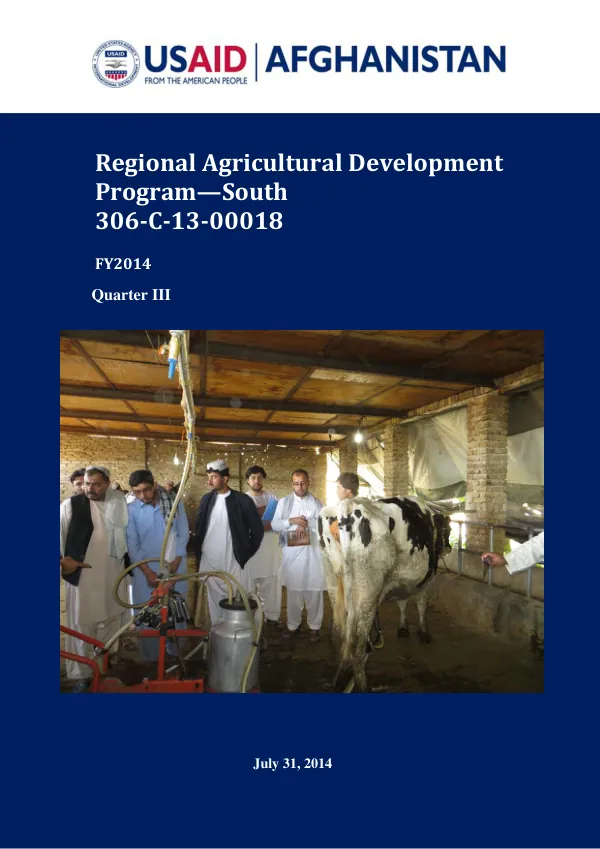
Regional Agricultural Development Program-South April – June 2014 Quarterly Report
The Regional Agricultural Development Program-South (RADP-S) aims to improve food and economic security for rural Afghans in the provinces of Kandahar, Helmand, Zabul, and Uruzgan.
2014 · 22 pages
Sign in to readA free account is required to download.
Abstract
To achieve this goal, RADP-S focuses on improving the productivity and profitability of the wheat, high value crops, and livestock value chains, while addressing policy, legal, and regulatory constraints affecting value chain development. The program supports the consolidation of licit economies to fuel sustainable long-term economic growth, including providing alternatives to poppy cultivation. RADP-S implementation approach dovetails with Afghan and U.S. government strategies in its focus on advancing food security, regenerating agribusiness, and increasing agriculture sector jobs and incomes. The program aims to strengthen the capacity of producers, associations, traders, and agribusinesses to respond to market demands; facilitate lasting market linkages between value chain actors; and support an enabling environment that allows the private sector to thrive. RADP-S places the Afghan private sector at the forefront of implementation and addresses key crosscutting issues of women's empowerment, agribusiness value chain facilitation, and alternative development in all facets of the program. In Quarter III, RADP-S positioned itself to aggressively implement project activities upon execution of the Memorandum of Understanding (MOU) between the Ministry of Agriculture, Irrigation, and Livestock (MAIL) and USAID/RADP-S. The productivity and production unit focused on setting the stage for training of trainer (TOT) activities and establishment of demonstration farms. The unit completed 29 training modules spanning pre-harvest, harvest, and post-harvest techniques for wheat and high value crops, environmental compliance, food safety and hygiene, nutrition, and Hazard Analysis and Critical Control Points (HACCP). These modules will be immediately employed next quarter to build the capacity of RADP-S' key implementing partners' (KIPs) 54 master trainers at the AMTEX Technical Training Facility. The master trainers will then transfer this knowledge to 78 lead farmers through trainings at the KIPs' provincial offices. In the meantime, RADP-S and the KIPs coordinated the process and criteria for selecting lead farmers and landowners, identifying and leasing demonstration farms sites, and procuring the necessary materials to establish the farms. Upon execution of the MOU, the KIPs organized coordination meetings with relevant district stakeholders such as district governors, directors of the Directorate of Agriculture, Irrigation and Livestock (DAIL), the District Development Assembly (DDA), and shura members. At these meetings, they garnered the requisite cooperation to establish district offices and to collaboratively identify eligible lead farmer candidates and demonstration farm sites. On June 22-23, RADP-S hosted the Provincial Governors, District Governors, and DAIL Directors Coordination Meeting at the Baron. The meeting was attended by the provincial governor from each of the four target provinces, 11 district governors, provincial DAIL directors, KIP leadership, and members of USAID such as the Office of Agriculture Director Wayne Nilsestuen. At the meeting, RADP-S leadership presented an overview of the goals and activities of the program and focused on opportunities for mutually advantageous collaboration between RADP-S, the DAILs, and provincial leadership. Director Nilsestuen delivered the opening address, emphasizing that RADP-S is the first of four agricultural programs designed to improve food and economic security for rural Afghans over the long term. The Dutch Committee for Afghanistan (DCA), RADP-S' implementation partner for livestock activities, made significant progress in establishing demonstration farms and training farmers in best practices for livestock production. The DCA also coordinated with the Provincial Veterinary Department (PVD) and the Provincial Veterinary Team (PVT) to establish a veterinary field unit (VFU) in each of the four target provinces. The VFU will provide veterinary services to farmers, including vaccinations, deworming, and disease diagnosis. The DCA also worked with the KIPs to establish a system for monitoring and evaluating the impact of the program, including tracking the number of farmers trained, the number of demonstration farms established, and the impact on crop yields and livestock productivity. Overall, RADP-S made significant progress in Quarter III, positioning itself to aggressively implement project activities and build the capacity of farmers, associations, traders, and agribusinesses to respond to market demands. The program's focus on improving the productivity and profitability of the wheat, high value crops, and livestock value chains, while addressing policy, legal, and regulatory constraints affecting value chain development, is critical to achieving its goal of improving food and economic security for rural Afghans in the provinces of Kandahar, Helmand, Zabul, and Uruzgan.