CHEMONICS
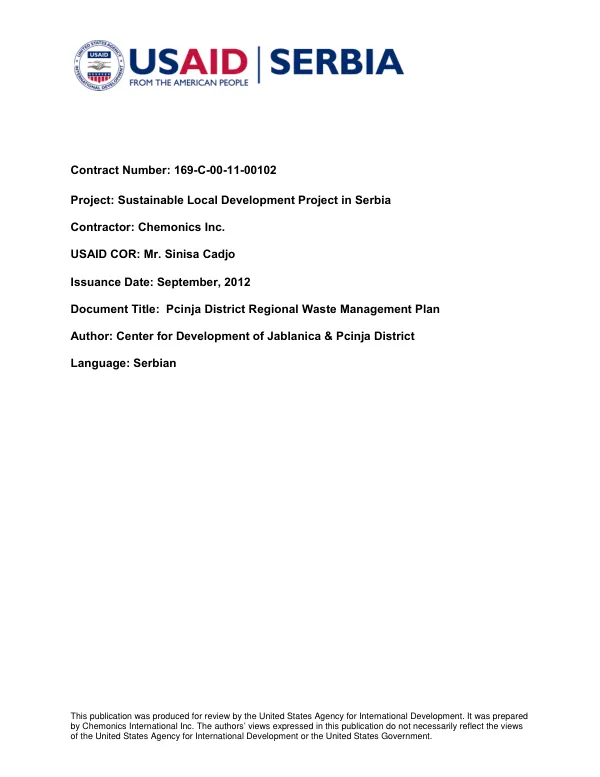
Regional Waste Management Plan for Pcinja District 2013-2023
The Pcinja District Regional Waste Management Plan was developed for the Pcinja District in Serbia.
2012 · 251 pages
Sign in to readA free account is required to download.
Abstract
The plan aims to establish a comprehensive waste management system for the region, addressing the current challenges and opportunities in waste management. The plan is based on the principles of sustainable development and the European Union's waste management directives. The Pcinja District is located in the southeastern part of Serbia, covering an area of approximately 2,680 square kilometers. The region has a population of around 90,000 people, with the majority living in rural areas. The district's economy is primarily based on agriculture, with a significant portion of the population engaged in farming and livestock production. The plan identifies several key challenges in waste management, including inadequate infrastructure, lack of public awareness, and insufficient institutional capacity. The current waste management system in the Pcinja District is characterized by a lack of segregation, inadequate collection and transportation, and insufficient treatment and disposal facilities. The plan proposes several strategies to address these challenges, including the establishment of a regional waste management system, improvement of waste collection and transportation infrastructure, and development of public awareness and education programs. The plan also recommends the implementation of waste reduction and recycling programs, as well as the development of a waste-to-energy facility. The plan identifies several key stakeholders, including the Pcinja District authorities, local communities, and private sector companies. The plan proposes the establishment of a regional waste management authority, responsible for coordinating and implementing the waste management system. The plan outlines several key activities, including the development of a waste management infrastructure, implementation of waste reduction and recycling programs, and establishment of a waste-to-energy facility. The plan also proposes the development of public awareness and education programs, as well as the establishment of a monitoring and evaluation system to track progress and identify areas for improvement. The plan is based on a comprehensive analysis of the current waste management situation in the Pcinja District, including an assessment of the existing infrastructure, institutional capacity, and public awareness. The plan also takes into account the European Union's waste management directives and the principles of sustainable development. The implementation of the plan is expected to have several benefits, including improved waste management practices, reduced environmental pollution, and increased public awareness and education. The plan is also expected to contribute to the development of a more sustainable and environmentally friendly economy in the Pcinja District. The plan proposes several key indicators to measure progress and evaluate the effectiveness of the waste management system. These indicators include waste generation rates, waste collection and transportation rates, and waste treatment and disposal rates. The plan also proposes the establishment of a monitoring and evaluation system to track progress and identify areas for improvement. The plan is expected to be implemented over a period of 10 years, with several key milestones and deadlines. The plan proposes the establishment of a project management team, responsible for coordinating and implementing the plan. The plan also proposes the development of a budget and financing plan, to ensure the sustainability of the waste management system.