USAID DEC
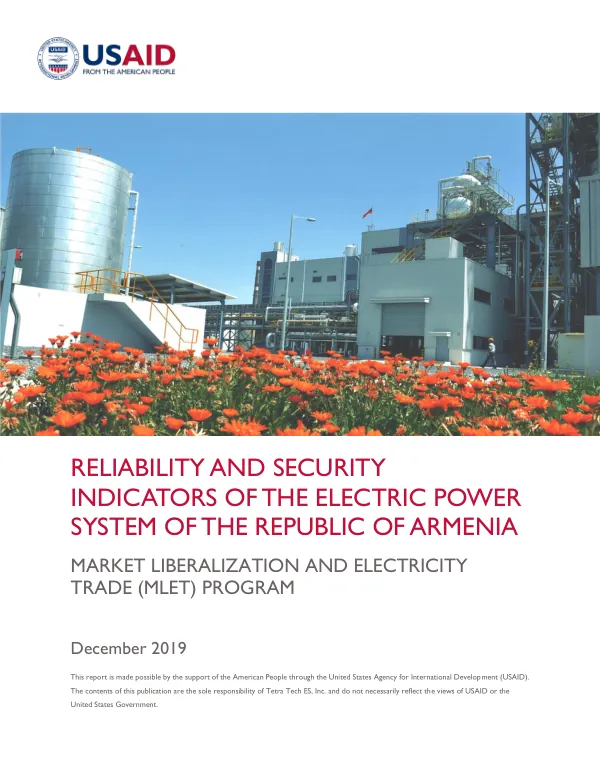
Reliability and Security Indicators of the Electric Power System of the Republic of Armenia
Sign inTETRA TECH ESI, INC.
Reliability and Security Indicators of the Electric Power System of the Republic of Armenia
The Electric Power System (EPS) of the Republic of Armenia is a complex installation of electrical energy generation, transmission, and distribution.
2019 · 37 pages
Sign in to readA free account is required to download.
Abstract
The EPS is defined as a system of interconnected power generation, transmission, and distribution facilities, including relay protection, emergency control systems, and communication equipment. The reliability and security indicators of the EPS are assessed through the analysis and modeling of various scenarios, including normal, exceptional, and extraordinary contingency events. The assessment of reliability and security indicators is carried out by studying the disturbances of the EPS, which can be caused by short circuits, operation of relay protection devices, or other types of failures. The classification of normative contingencies is as follows: normal contingencies, which include the outage of an element of the EPS due to a short circuit or the operation of a relay protection device; exceptional contingencies, which include the outage of a double circuit transmission line or the shutdown of a power station; and extraordinary contingency events, which include the simultaneous outage of two independent transmission lines or the onset of an asynchronous state of the EPS. The EPS has a normal state, which is characterized by a steady or sustainable state of operation, and a transient state, which is characterized by a significant change in parameters. The EPS also has a synchronous state, which is characterized by the disturbance of the operation of the parts of the system. The stability of the EPS is defined as the ability of the EPS to move to a normal steady or contingency sustainable state after minor disturbances. The dynamic stability of the EPS is defined as the ability of the EPS to move to a steady state or sustainable state after significant changes in the state. The reliability of the EPS is defined as the ability of the EPS to ensure generation, transmission, and supply of electric power to consumers by the set parameters of the unified process. The security of the EPS is defined as the ability of the EPS to ensure that the potential disturbances, such as short circuits and outages of elements, are safe for the parts of the EPS and human health. The EPS has a working regime, which involves the operation and management of the EPS, including the dispatching and short-term planning of the EPS states and schemes, operative management and coordination, design and maintenance of the EPS, and the operation and maintenance of power equipment and control systems. The EPS has a transmission grid, which is responsible for the transmission of electric power from the power generation facilities to the consumers. The transmission grid is composed of transmission lines, substations, and other equipment. The EPS has a normal scheme, which is the operative disposition of the EPS that ensures maintaining the normal state of the EPS. The normal scheme is designed to ensure the safe and reliable operation of the EPS, including the operation of relay protection devices, relay protection devices, and other equipment. The EPS has a relay protection system, which is responsible for detecting and preventing short circuits and other types of failures. The relay protection system is designed to ensure the safe and reliable operation of the EPS, including the operation of relay protection devices, relay protection devices, and other equipment. The EPS has an emergency control system, which is responsible for controlling the EPS in emergency situations, such as short circuits or other types of failures. The emergency control system is designed to ensure the safe and reliable operation of the EPS, including the operation of relay protection devices, relay protection devices, and other equipment. The EPS has a communication system, which is responsible for transmitting information between the EPS and the consumers. The communication system is designed to ensure the safe and reliable operation of the EPS, including the operation of relay protection devices, relay protection devices, and other equipment. The EPS has a power generation system, which is responsible for generating electric power for the EPS. The power generation system is composed of power generation facilities, including power plants, wind farms, and other equipment. The EPS has a power transmission system, which is responsible for transmitting electric power from the power generation facilities to the consumers. The power transmission system is composed of transmission lines, substations, and other equipment. The EPS has a power distribution system, which is responsible for distributing electric power to the consumers. The power distribution system is composed of distribution lines, substations, and other equipment. The EPS has a power supply system, which is responsible for supplying electric power to the consumers. The power supply system is composed of power supply facilities, including power plants, wind farms, and other equipment. The EPS has a power quality system, which is responsible for ensuring the quality of the electric power supplied to the consumers. The power quality system is composed of power quality facilities, including power plants, wind farms, and other equipment. The EPS has a power protection system, which is responsible for protecting the EPS from short circuits and other types of failures. The power protection system is composed of power protection facilities, including power plants, wind farms, and other equipment. The EPS has a power control system, which is responsible for controlling the EPS in normal and emergency situations. The power control system is composed of power control facilities, including power plants, wind farms, and other equipment. The EPS has a
Related documents