DELOITTE CONSULTING, LLP
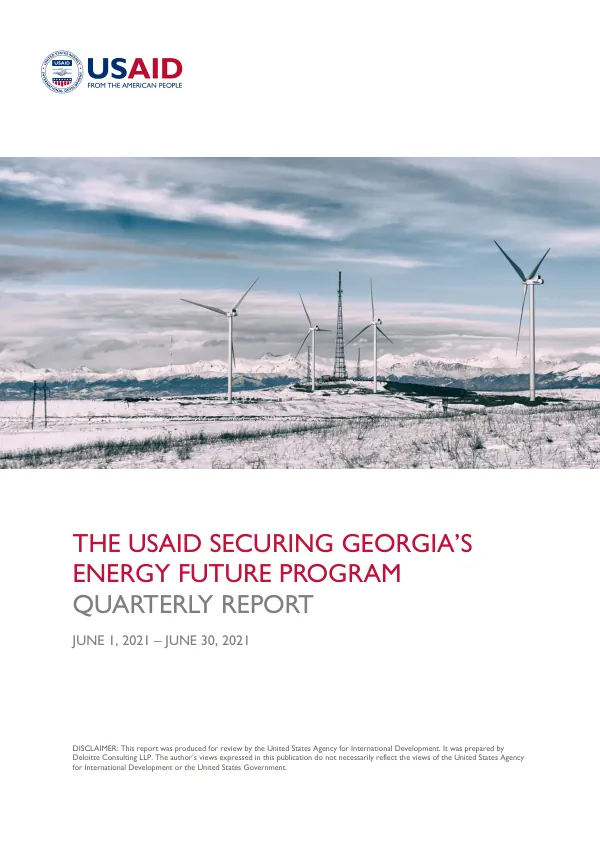
USAID Securing Georgia's Energy Future Program Quarterly Report
The USAID Securing Georgia's Energy Future Program aims to improve Georgia's energy security and reduce its susceptibility to malign influence through sound long-term policymaking and governance, increased private-sector investment in indigenous renewable energy production, building the capacity of Georgian institutions to effectively and sustainably manage domestic energy markets, and improved energy sector resilience to cyber threats.
2021 · 60 pages
Sign in to readA free account is required to download.
Abstract
The program will enable the entire Georgian economy to be more resilient to malign pressures and better equipped to sustain economic growth and create more economic opportunities for the Georgian people. The program's objectives are multifaceted, focusing on four key areas: Improved Energy System Planning, Increased Investment to Promote Energy Sector Resilience, Improved Governance and Operations of Well-Functioning Georgian Energy Market, and Reduced Cybersecurity Vulnerabilities. To achieve these objectives, the program will support the further development of Georgia's energy sector into an open, regionally-integrated, market-driven system capable of independently planning, financing, and implementing solutions to Georgia's energy challenges. Implementation of the program began with the official launch of the USAID Securing Georgia's Energy Future Program in July 2021. The program's management and operations are overseen by Deloitte Consulting LLP, with a focus on work planning, year 1 reports, and progress tracking. The program's quarterly reports will provide updates on progress, challenges, and obstacles encountered during the period of performance. The program's progress is being monitored and evaluated through a variety of mechanisms, including the Knowledge Management (KM) Plan, Monitoring Evaluation and Learning (Me&L), and Gender & Youth. The program is also engaging with cross-cutting activities, including Donor Coordination, Communication, and Environmental Evaluation. The program's stakeholders include a range of organizations, including the Georgian government, private sector companies, and international organizations. The program's quarterly report for July 1, 2021, to September 30, 2021, highlights progress made in the first quarter of the program. The report provides an overview of the program's objectives, management and operations, and progress made in the four key areas of focus. The report also highlights challenges and obstacles encountered during the quarter and outlines steps being taken to address these issues. In terms of specific progress, the program has made significant strides in improving energy system planning, with the development of a comprehensive energy plan for Georgia. The program has also made progress in increasing investment in the energy sector, with several private sector companies expressing interest in investing in renewable energy projects. Additionally, the program has made progress in improving governance and operations of the Georgian energy market, with the establishment of a new energy regulatory body. The program's quarterly report provides a comprehensive overview of progress made in the first quarter of the program and highlights the challenges and obstacles that still need to be addressed. The report provides a roadmap for future progress and outlines the steps being taken to achieve the program's objectives.