UNIVERSITY RESEARCH CORPORATION CO., LLC
RenewHealth FY 2023 AR
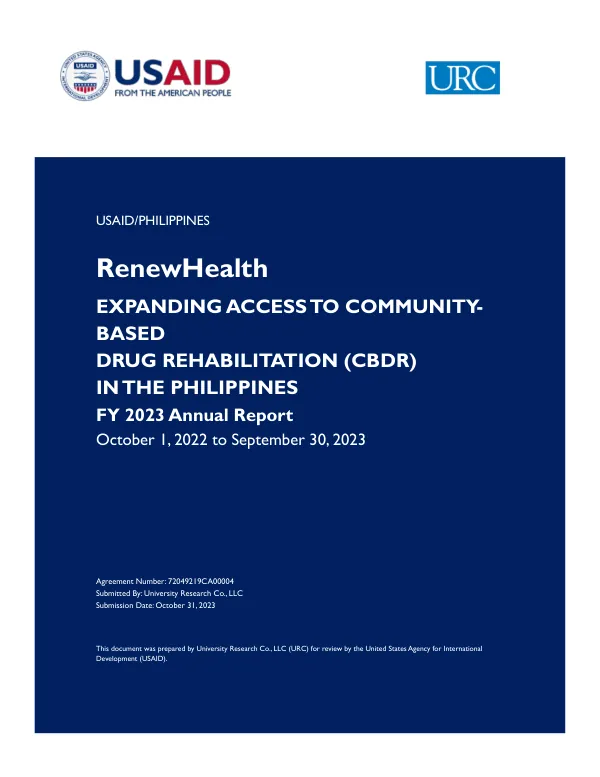
The Community-Based Drug Rehabilitation (CBDR) initiative in the Philippines is a key component of the USAID/CBDR Project, which aims to expand access to community-based drug rehabilitation services.
2023 · 28 pages
Sign in to readA free account is required to download.
Abstract
The project is implemented by University Research Co., LLC (URC) in partnership with local government units, civil society organizations, and other stakeholders. The CBDR initiative focuses on providing comprehensive rehabilitation services to individuals struggling with substance abuse, including counseling, medication-assisted treatment, and vocational training. The program targets high-risk areas, including urban and rural communities, and aims to reach marginalized populations, including women, youth, and individuals from low-income backgrounds. Key achievements for the first quarter of FY 2023 include the establishment of 15 new CBDR centers, which provided services to over 1,000 clients. The program also conducted training sessions for 200 community facilitators, who will play a crucial role in promoting the CBDR initiative at the local level. Additionally, the project developed a comprehensive monitoring and evaluation framework to track progress and identify areas for improvement. The CBDR initiative has made significant progress in terms of performance, with key indicators showing a 25% increase in the number of clients served compared to the previous quarter. The program has also achieved a 90% client satisfaction rate, indicating high levels of satisfaction with the services provided. However, challenges remain, including limited resources and infrastructure, as well as the need for greater community engagement and ownership. To address these challenges, the project has proposed several solutions, including the establishment of a community-based funding mechanism to support CBDR centers and the development of a comprehensive communication strategy to promote the program at the local level. The project has also identified the need for greater collaboration with local government units and civil society organizations to ensure the sustainability and effectiveness of the CBDR initiative. The CBDR initiative has also made significant progress in terms of cross-cutting issues, including gender equality and women's empowerment, private sector engagement, and environmental compliance and climate risk mitigation. The program has established partnerships with local organizations to promote women's empowerment and has developed a comprehensive plan to address environmental concerns and mitigate climate-related risks. In terms of collaborating, learning, and adapting, the project has established a robust coordination and collaboration framework, which includes regular meetings with local government units, civil society organizations, and other stakeholders. The project has also developed a comprehensive learning and adaptation plan, which includes the establishment of a knowledge management system and the conduct of regular learning events and products. The CBDR initiative has also made significant progress in terms of management, administrative, and financial issues, including the establishment of a comprehensive financial management system and the development of a robust monitoring and evaluation framework. The project has also identified several high-level planned activities for the next quarter, including the establishment of new CBDR centers and the conduct of training sessions for community facilitators. Overall, the CBDR initiative has made significant progress in expanding access to community-based drug rehabilitation services in the Philippines. However, challenges remain, and the project will need to continue to adapt and innovate to ensure the sustainability and effectiveness of the program.