USAID DEC
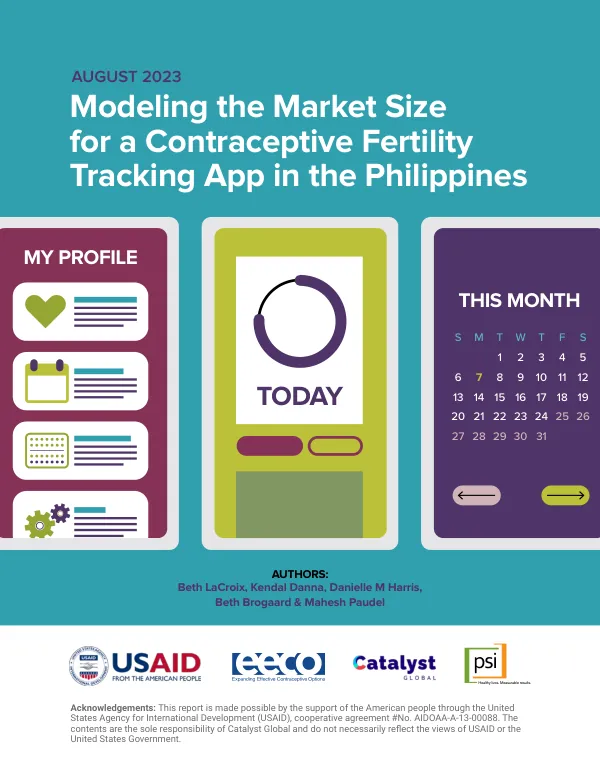
Modeling the Market Size for a Contraceptive Fertility Tracking App in the Philippines
Sign inPOPULATION SERVICES INTERNATIONAL/DKT INTERNATIONAL
Modeling the Market Size for a Contraceptive Fertility Tracking App in the Philippines
The population of women of reproductive age in the Philippines is a key factor in estimating the market size for a Contraceptive Fertility Tracking App (CFTA).
2023 · 16 pages
Sign in to readA free account is required to download.
Abstract
According to the World Population Prospects, the female population of reproductive age (18-49) in the Philippines was obtained using the Female population by single age, region, subregion, and country, annually, medium fertility variant estimate. The study population for the CFTA market size estimate consists of women who have access to a smartphone with internet capabilities and have ever used or might ever use a family planning (FP) method in the future. Respondents were recruited from an online research panel in the Philippines, with a total of 1600 participants meeting the study inclusion criteria for the online quantitative survey. A smaller quantitative validation survey was conducted offline to verify the representativeness of the online survey population responses. The online quantitative survey and offline validation survey collected data on respondent demographics, current FP use, and willingness to use and pay for a CFTA. Participants were shown a 13-minute video introducing a hypothetical CFTA, which combined several key features of actual, existing apps on the market. The video detailed the app's effectiveness, how it works, and that it can be used offline, and compared and contrasted its features with other currently available contraceptive methods. The CFTA market size model uses three main sources of information: the population of women of reproductive age in the Philippines, data collected from consumer research conducted in the Philippines, and adjustment factors made to survey responses. The model includes adjustments to account for overestimation, exaggeration, and desirability bias. For example, women who were "very unlikely", "somewhat unlikely", or "somewhat likely" to start a new method in the next 12 months were removed from the market size estimate, as well as those who were "maybe", "probably", or "definitely not interested" in using a CFTA. The model also includes adjustments to account for the likelihood of women to download and use a CFTA. Women who were "very likely" or "somewhat likely" to download the app now were included, with a 75% and 50% discount factor applied, respectively. Additionally, women who stated they would use the app for pregnancy prevention rather than helping to plan a pregnancy, or tracking menstrual cycles or health changes, were included. The model also accounts for the likelihood of women to use a CFTA instead of their current method. The study found that 25% of users abandon mobile apps after one use, and this discount factor was applied to estimate use for the CFTA. The results of the study indicate that there is a potential market for a CFTA in the Philippines, with a significant number of women expressing interest in using such an app. However, the actual market size is likely to be smaller due to the adjustments made to account for overestimation and desirability bias.
Related documents