USAID DEC
Renforcement de la gestion de la chaîne d’approvisionnement pour la planification familiale
Sign inWORLD HEALTH ORGANIZATION
Renforcement de la gestion de la chaîne d’approvisionnement pour la planification familiale
The availability of a wide range of contraceptive methods is a key factor in supporting an individual's ability to plan and space pregnancies.
2020 · 8 pages
Sign in to readA free account is required to download.
Abstract
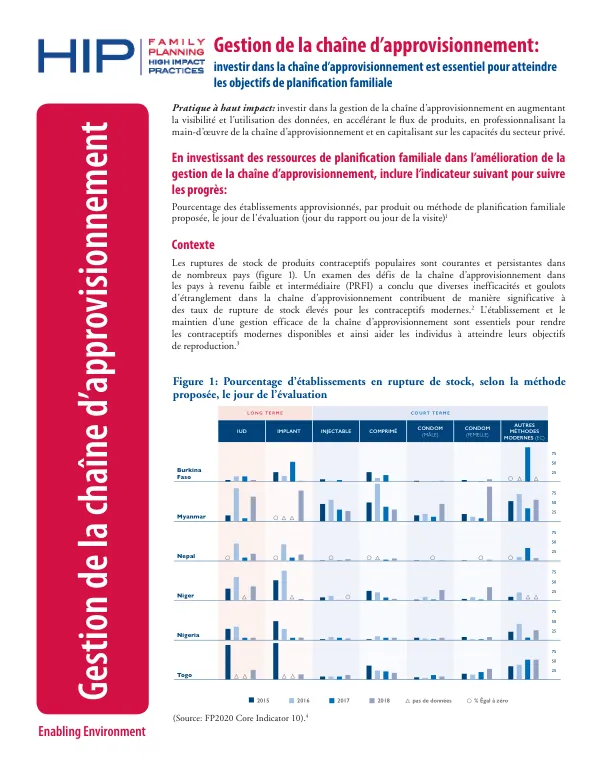
In low- and middle-income countries, it is estimated that the shortage of family planning products represents up to one-third of unmet family planning needs. The lack of access and supply chain failures are among the most cited reasons in low- and middle-income countries to explain unsatisfied demand, non-use, and interruption of contraception. A reliable stock of contraceptives supports voluntary choice - an important element in user satisfaction and continuation of the method. Contraceptive use is higher in contexts where the offer of contraceptive methods is constant. Data from East Africa indicate that a woman living in a region with an additional contraceptive method was 50% more likely to report using contraception than a woman living in a region offering fewer choices. Similar results have been documented in Haiti, Malawi, and Ethiopia. Effective supply chains support women's choice of modern contraception and have the potential to respond to latent demand for methods that were not previously available. This effect is partly due to the improvement of service quality and the reduction of stockouts of necessary contraceptive methods and related supplies and equipment. This has been illustrated by the use of the Informed Push Model (IPM) in Senegal, where national consumption of modern contraception increased by 48% in one year due to the availability of reliable products. Investing in supply chain management is essential to achieve family planning goals. A solid supply chain can contribute to high-impact family planning programs by increasing visibility and utilization of data for continuous improvement. The rapid and efficient movement of family planning products through the supply chain depends on a complex series of processes managed by different supply chain actors worldwide, including forecasting, manufacturing, procurement, transportation, inventory management, and delivery. Collecting and analyzing good data can provide the visibility needed to help governments, partner countries, manufacturers, and global buyers make informed decisions about estimating demand, purchasing, and distributing products, and promoting adequate funding. Routine evaluations of the supply chain provide information to identify and address process bottlenecks. This is one of the fastest and most effective ways to improve supply chain performance. In Kaduna State, supply chain evaluations in 2016 identified "fragmented logistics data collection systems, duplication, waste, and significant quality-price ratio losses." (p.5) Based on the evaluation results, the state government designed and launched the supply chain transformation project to address these issues. The four key areas of intervention to strengthen supply chain performance and respond to family planning product needs are: increasing visibility and utilization of data for continuous improvement, accelerating product flow throughout the supply chain, establishing and supporting competent and professional supply chain personnel, and capitalizing on private sector supply chain capacity, where possible. Effective supply chain management organizes the vast network of supply chain actors - buyers, manufacturers, shippers, distributors, warehouse managers, and service providers - into a system that ensures rapid delivery of products from ports to central warehouses and national infrastructure, and ultimately to service points and communities. A well-functioning supply chain works when these actors collaborate to make decisions about product transportation, including the quantity to transport, the timing, and the method. To improve supply chain performance and increase access to products, they need data visibility that allows them to understand together where products are in the system and which processes are blocking their movement. The supply chain is a critical component of the global health system, and its effective management is essential to ensure the availability of essential health products, including family planning products. Investing in supply chain management is essential to achieve family planning goals. A solid supply chain can contribute to high-impact family planning programs by increasing visibility and utilization of data for continuous
Related documents