USAID DEC
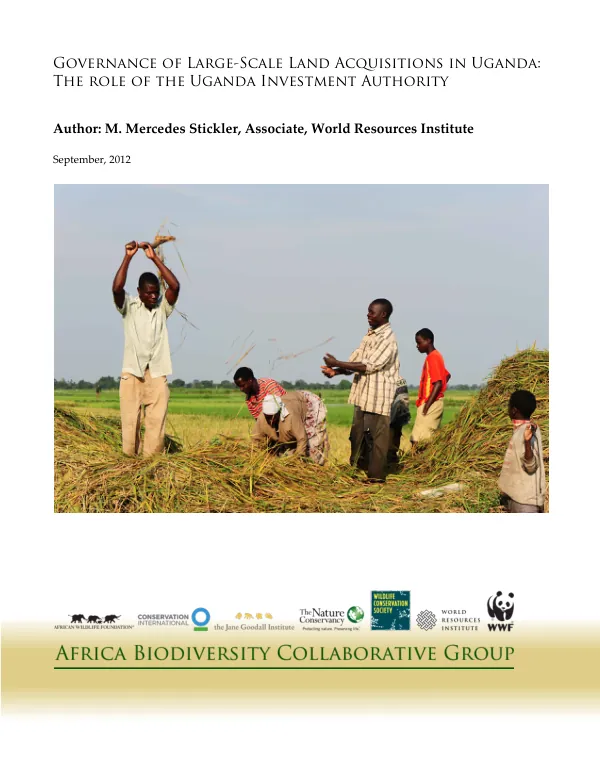
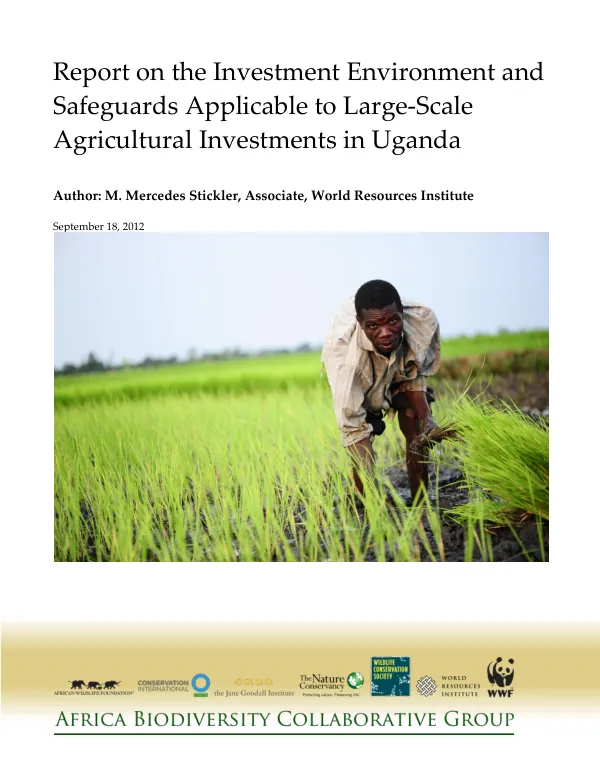
Report on the investment environment and safeguards applicable to large-scale agricultural investments in Uganda
Sign inAFRICAN BIODIVERSITY COLLABORATIVE GROUP
Report on the investment environment and safeguards applicable to large-scale agricultural investments in Uganda
The agricultural investment environment in Uganda is characterized by a significant increase in investor interest in large-scale land acquisitions for agriculture and forestry production.
2012 · 74 pages
Sign in to readA free account is required to download.
Abstract
Following the spike in commodity prices in 2007-2008, investors expressed interest in 56 million ha of land for agriculture and forestry production in less than one year, with sub-Saharan Africa accounting for 2/3 of this expressed demand. Uganda is one of the countries with a history of allocating land for large-scale agricultural production, with a deal underway to lease 840,000 ha to Egypt for wheat and maize production. The Uganda Investment Authority (UIA) plays a key role in facilitating investor access to land, and its enabling legislation, the Investment Code Act of 1991, provides the framework for land acquisition. The UIA is responsible for promoting and facilitating investment in Uganda, including the provision of information on investment opportunities and the facilitation of land acquisition. The UIA also has the authority to grant licenses to investors and to provide support for investment projects. Land tenure in Uganda is governed by the Land Act of 1998, which provides for the registration of land titles and the protection of land rights. However, the implementation of this law has been inconsistent, and many rural communities lack secure land tenure. The Uganda Land Commission (ULC) is responsible for the administration of land in Uganda, including the registration of land titles and the resolution of land disputes. The social and environmental safeguards applicable to large-scale agricultural investments in Uganda are governed by the Environmental Impact Assessment (EIA) regulations and the National Environmental Management Authority (NEMA) Act of 1995. The EIA regulations require investors to conduct an environmental impact assessment before commencing a project, and NEMA is responsible for ensuring that investors comply with environmental regulations. Recent large-scale land acquisitions in Uganda have raised concerns about the social and environmental implications of these investments. For example, the allocation of land in the Tana Delta for sugar cane plantations has displaced hundreds of families and destroyed one of Africa's most important bird habitats. Similarly, the allocation of natural forest in Cameroon, DR Congo, and Congo (Brazzaville) for palm oil plantations has raised concerns about the impact on biodiversity and ecosystem services. The social safeguards framework for agricultural investments in Uganda includes provisions for the protection of land rights, the provision of fair compensation for land acquisition, and the promotion of sustainable livelihoods for local communities. The environmental safeguards framework includes provisions for the protection of natural resources, the prevention of pollution, and the promotion of sustainable land use practices. Implementation of the social and environmental safeguards framework is a critical challenge for Uganda. The UIA and other government institutions have a key role to play in ensuring that investors comply with these safeguards, and that the social and environmental implications of large-scale land acquisitions are carefully considered.