USAID DEC
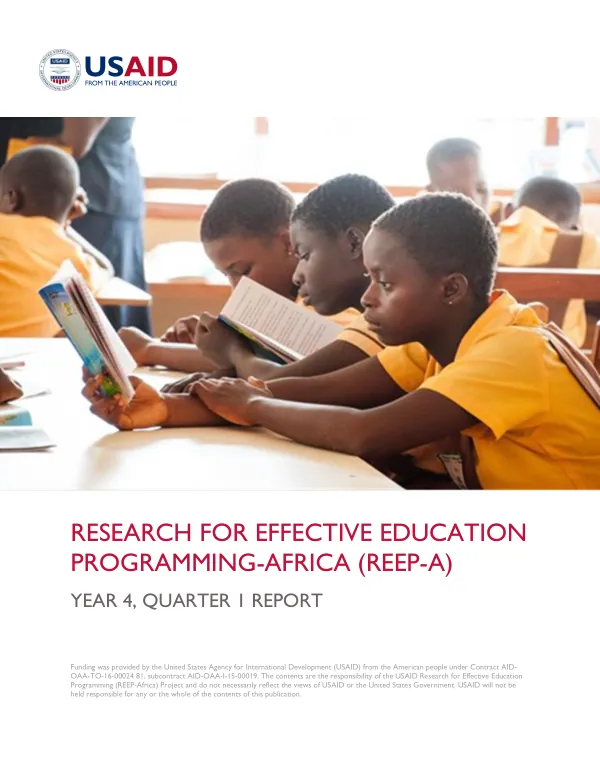
Research for Effective Education Programming – Africa (REEP-A) Year 4, Quarter 1 Report
Sign inECO CONSULTING GROUP
Research for Effective Education Programming – Africa (REEP-A) Year 4, Quarter 1 Report
The Research for Effective Education Programming – Africa (REEP-A) project aims to provide the U.S.
2020 · 16 pages
Sign in to readA free account is required to download.
Abstract
Agency for International Development (USAID) Africa Bureau, overseas Missions, and partner organizations with concrete research contributions on USAID education initiatives to inform evidence-based investment, decision-making, and the prioritization of needs. REEP-A will contribute to USAID's education aims in Africa by providing technical and advisory services focused on research and capacity building that intend to enhance the quality and effectiveness of USAID activities. REEP-A will provide practical and action-oriented gender-sensitive research that will be applied to both project design and implementation. The project aims to strengthen the relationships and links between project evaluation, design, and implementation. In addition, REEP-A will contribute to the capacity development of education personnel and partners by enhancing the use of research in decision-making, mainstreaming the application of feedback-loops and lessons learned into project design and implementation, and expanding the evidence and knowledge base on education initiatives. USAID's Education Strategy, issued in 2011, has promoted the rigorous use of evidence-based programming across the Strategy's three education goals, with a particular emphasis on the measurement of access to education and early grade reading improvements. The education goals set targets for 2015, which centered on early grade reading, workforce development, and education in crisis and conflict-affected environments. REEP-A will specifically focus on improvement in early grade reading and the measurement of equitable access to education in crisis and conflict environments (Goals 1 and 3). In Year 4, Quarter 1, REEP-A activities included project administration, planning, and technical activities. Under Result 1, Deliver Country and Regional Education Data Trend Snap Shots (Requirement 1.1) and Deliver Education Data Briefs (Requirement 1.2) have been allocated to occur in Year 4. Dexis Consulting Group (Dexis) has continued discussions with USAID throughout Quarter 1, Year 4 to determine the most relevant research topics to fulfill Requirements 1.1 and 1.2. On October 8, 2019, the proposed research topics for Year 4 were submitted for USAID review, with an additional two potential research topics submitted on October 10, 2019. On October 16, 2019, USAID provided approval on selected proposed research topics. In Year 4, work under Deliver Country and Regional Education Data Trend Snap Shots (Requirement 1.1) will center around education financing. Specifically, the Data Trend Snapshot will include an overview of international aid to education, including trends over time in sub-Saharan Africa, including analysis of bilateral and multilateral donors with comparison to other sectors. The specific countries in sub-Saharan Africa have not yet been selected by USAID. However, discussions with USAID are ongoing to determine the most relevant research topics to fulfill Requirements 1.1 and 1.2. REEP-A will continue to work with USAID to identify the most pressing research needs and to develop research products that will inform evidence-based investment, decision-making, and the prioritization of needs. REEP-A's research will focus on the measurement of equitable access to education and early grade reading improvements. The project will provide practical and action-oriented gender-sensitive research that will be applied to both project design and implementation. REEP-A will contribute to the capacity development of education personnel and partners by enhancing the use of research in decision-making, mainstreaming the application of feedback-loops and lessons learned into project design and implementation, and expanding the evidence and knowledge base on education initiatives. REEP-A's activities in Year 4, Quarter 1, have laid the groundwork for the project's continued success in providing research contributions to inform evidence-based investment, decision-making, and the prioritization of needs. The project will continue to work with USAID to identify the most pressing research needs and to develop research products that will inform evidence-based investment, decision-making, and the prioritization of needs.
Related documents