ECO CONSULTING GROUP
Teacher Language and Literacy Assessment (TLLA) Final Report Overview
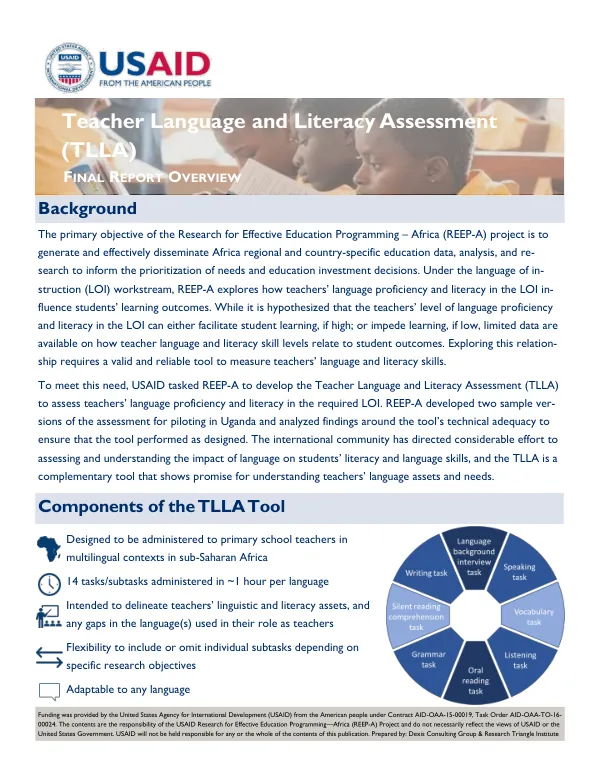
The Teacher Language and Literacy Assessment (TLLA) is a tool designed to assess primary school teachers' language proficiency and literacy in the language of instruction (LOI) in multilingual contexts in sub-Saharan Africa.
2021 · 2 pages
Sign in to readA free account is required to download.
Abstract
The assessment is intended to delineate teachers' linguistic and literacy assets, as well as any gaps in the language(s) used in their role as teachers. The TLLA was developed by the Research for Effective Education Programming – Africa (REEP-A) project, which aims to generate and disseminate education data, analysis, and research to inform education investment decisions. The project's language of instruction (LOI) workstream explores how teachers' language proficiency and literacy in the LOI influence students' learning outcomes. The TLLA consists of 14 tasks/subtasks, which are administered in approximately one hour per language. The assessment is designed to be adaptable to any language and can be modified to include or omit individual subtasks depending on specific research objectives. The tool is intended to provide a valid and reliable measure of teachers' language and literacy skills. The TLLA was piloted in Uganda, with two rounds of cognitive interviews and a field test involving 18 English and 18 Luganda instruments, as well as a pilot with 149 English and 147 Luganda instruments. The findings from the field-test and pilot stages in Uganda indicate that the assessment is beneficial for teachers, allowing them to identify their strengths and weaknesses and improve their language and literacy skills. The assessment results show that teachers' reaction to the TLLA was positive, with many expressing gratitude for the opportunity to take the assessment. The results also indicate that the assessment components are linked to language and literacy skills needed to perform well in their roles as primary school teachers. The analysis of the data collected using sample versions of the tool in both languages found that ten of the 13 assessment components in English and six of the 12 components in Luganda had high internal consistency among items, as measured by a Cronbach's alpha of 0.70 or greater. The results also revealed that selecting just one of the two grammar subtasks is sufficient, and that correcting student writing is not a direct substitute for the writing prompt. The results also indicate that teachers on the Luganda assessment scored higher than teachers on the English assessment, with only the Luganda correcting student writing subtasks presenting a floor effect. Several tasks/subtasks presented an apparent ceiling effect, indicating that most teachers in this sample were able to complete the oral and written tasks and subtasks expected of their primary grade students with high accuracy and comprehension. The interview results aligned fairly well with teachers' self-reported abilities, even when self-reported abilities were low. The assessment requires about one hour of a teacher's time to complete in each language. Recommendations for subsequent TLLA pilots include experimenting with adapting tasks and sharing results with local stakeholders and the international education community to improve the tool's effectiveness for a variety of purposes and contexts. The TLLA can serve as an example of how to develop a tool for similar contexts and spur other research on the effectiveness of assessment tools.