USAID DEC
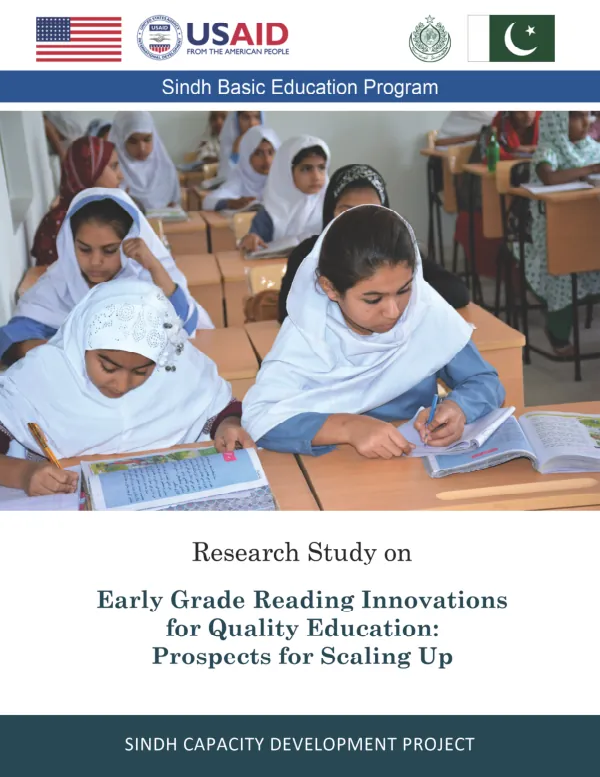
Research Study on Early Grade Reading Innovations for Quality Education: Prospects for Scaling Up
Sign inUSAID
Research Study on Early Grade Reading Innovations for Quality Education: Prospects for Scaling Up
The Early Grade Reading Innovations for Quality Education: Prospects for Scaling Up research study was conducted by a research team from the Aga Khan University Institute for Educational Development for USAID's Sindh Capacity Development Project.
2019 · 102 pages
Sign in to readA free account is required to download.
Abstract
The study aimed to investigate the effectiveness of two reading innovation models, the Teacher Learning Activity (TLA) model and the Group Teaching (GT) model, in improving early grade reading outcomes in Sindh, Pakistan. The study employed a mixed-methods approach, combining both quantitative and qualitative data collection and analysis methods. The quantitative analysis involved the administration of the Early Grade Reading Assessment (EGRA) tool to a sample of students in Cohort-1 and Cohort-2, while the qualitative analysis involved the collection of data through classroom observations, teacher interviews, and student surveys. The results of the quantitative analysis showed that students in the SRP (School Readiness Program) group, which received the TLA model intervention, performed significantly better on the EGRA assessment compared to the non-SRP group. The SRP group showed a higher percentage of students who could read at or above the expected grade level, particularly in the areas of phonemic awareness, alphabet knowledge, and reading comprehension. The qualitative analysis revealed that the TLA model was more effective in improving teacher practice and student outcomes compared to the GT model. Teachers who received the TLA model training reported higher levels of confidence and competence in teaching reading, and students in these classrooms showed higher levels of engagement and motivation. The study also found that the home literacy environment played a significant role in supporting student reading outcomes. Students from homes with higher levels of literacy and educational attainment showed better reading outcomes, while students from homes with lower levels of literacy and educational attainment showed poorer reading outcomes. The study's findings have implications for policymakers and educators seeking to improve early grade reading outcomes in Sindh, Pakistan. The results suggest that the TLA model is a more effective approach to improving teacher practice and student outcomes, and that the home literacy environment is a critical factor in supporting student reading outcomes. The study's findings also highlight the need for continued support and resources for teachers and schools to improve reading outcomes. The study's methodology involved the administration of the EGRA tool to a sample of students in Cohort-1 and Cohort-2. The EGRA tool assesses students' reading skills in four domains: phonemic awareness, alphabet knowledge, reading comprehension, and fluency. The study also collected data through classroom observations, teacher interviews, and student surveys. The study's results also showed that the GT model was less effective in improving teacher practice and student outcomes compared to the TLA model. Teachers who received the GT model training reported lower levels of confidence and competence in teaching reading, and students in these classrooms showed lower levels of engagement and motivation.
Related documents
Documents in this collection
 2019
2019USAID DEC
Variation Study Midline Report: A Mixed-Methods Experimental Study with Four Treatment Arms to Identify the Cost-Effectiveness of Different Ingredients of a Literacy Intervention for Early Grades: Evidence from the Pakistan Reading Project in KP
Open record 2018
2018USAID DEC