MANAGEMENT SYSTEMS INTERNATIONAL
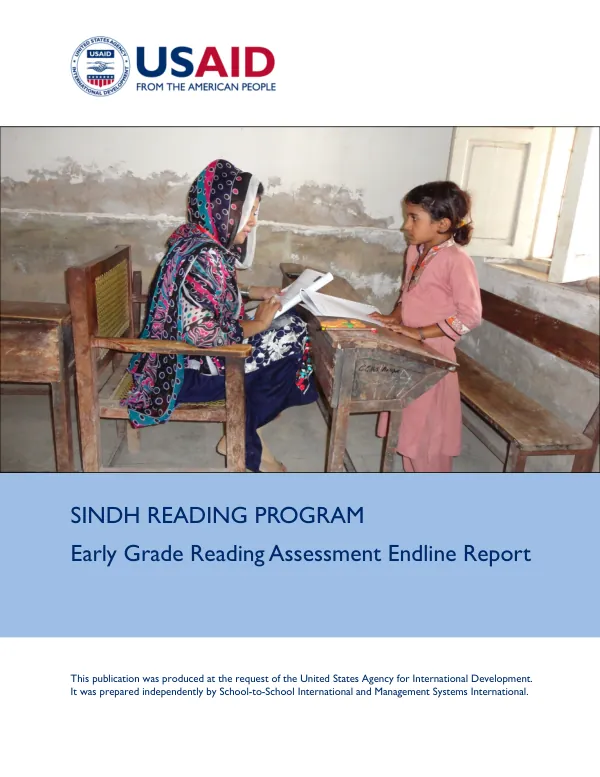
Sindh Reading Program Early Grade Reading Assessment Endline Report
The Sindh Reading Program (SRP) was implemented in the Sindh Province of Pakistan to improve early grade reading outcomes.
2019 · 219 pages
Sign in to readA free account is required to download.
Abstract
The program was designed to address the significant reading challenges faced by students in the province. Initial assessments conducted in the region identified a pressing need for improvement in reading skills, with students averaging 40% below regional benchmarks. The SRP was a collaborative effort between the Government of Sindh, the United States Agency for International Development (USAID), and School-to-School International (STS). The program's primary objective was to enhance reading skills among students in grades 1-3. To achieve this goal, the program implemented a range of interventions, including teacher training, instructional materials development, and community engagement. The Early Grade Reading Assessment (EGRA) was conducted to evaluate the effectiveness of the SRP. The assessment tool was developed to measure reading skills among students in grades 1-3. The EGRA results showed significant improvements in reading skills among students who participated in the program. In particular, the assessment revealed a 27% increase in reading accuracy among students in the SRP compared to the control group. The EGRA results also highlighted the importance of teacher training and instructional materials in improving reading skills. Teachers who received training in the SRP showed a higher level of confidence in teaching reading skills, and students who received instruction from these teachers demonstrated better reading outcomes. The assessment results also suggested that the SRP's focus on community engagement and parental involvement contributed to the program's success. The SRP's impact was not limited to reading skills. The program also contributed to improvements in student motivation and engagement. Teachers reported a significant increase in student motivation and engagement in reading activities, which was attributed to the program's focus on making reading more enjoyable and relevant to students' lives. The SRP's success was also attributed to the strong partnerships established between the program's stakeholders. The collaboration between the Government of Sindh, USAID, and STS ensured that the program was well-planned, well-implemented, and well-evaluated. The program's evaluation process was rigorous, and the results provided valuable insights into the program's effectiveness and areas for improvement. The SRP's findings have important implications for education policymakers and practitioners in Pakistan. The program's success demonstrates the potential of targeted interventions to improve reading skills among students in low-performing schools. The program's evaluation results also highlight the importance of teacher training, instructional materials, and community engagement in improving reading outcomes. The SRP's impact was not limited to the Sindh Province. The program's success has the potential to inform education policies and programs at the national level. The program's evaluation results provide valuable insights into the effectiveness of targeted interventions in improving reading skills among students in low-performing schools. The SRP's evaluation results also have implications for the broader education sector in Pakistan. The program's success demonstrates the potential of collaborative efforts between government agencies, international organizations, and local stakeholders to improve education outcomes. The program's evaluation results highlight the importance of rigorous evaluation and monitoring in ensuring the effectiveness of education programs.
Related documents