USAID
Resilience and Economic Growth in the Sahel - Enhanced Resilience
Implementation of the Sustainability Strategy in FY18 marked a significant transition for REGIS-ER, shifting from its successful scale-up phase to a sustainability phase.
2018 · 87 pages
Sign in to readA free account is required to download.
Abstract
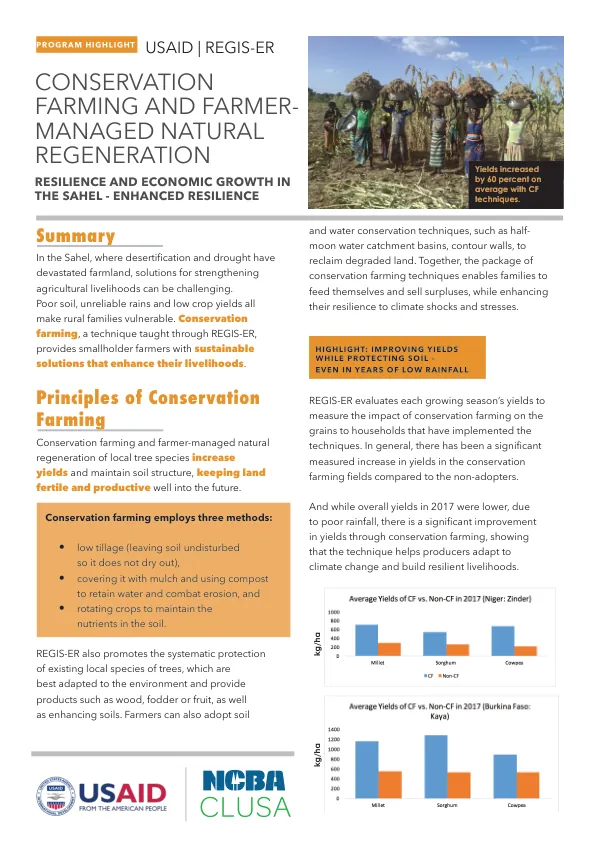
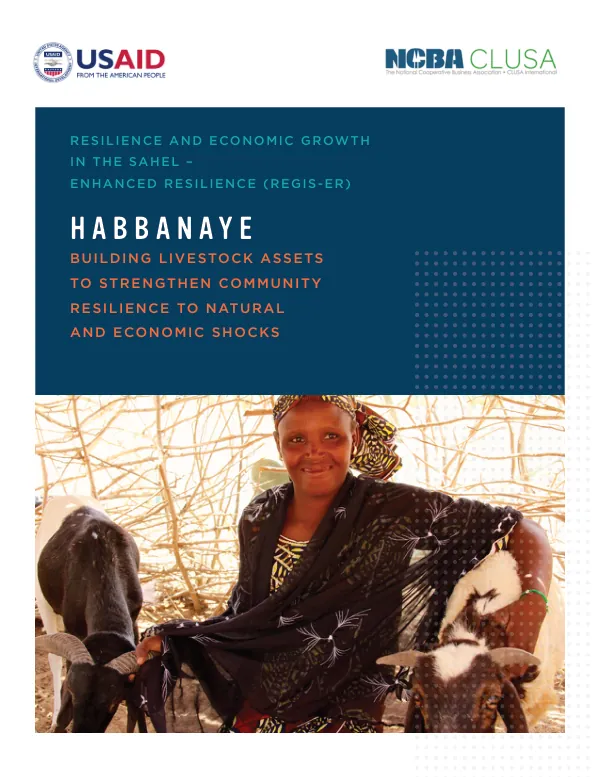
During this period, the project concentrated on resilience systems through a lens of local governance and institutions, narrowing its geographic focus to consolidate its achievements. REGIS-ER's sustainability strategy is based on the empowerment of local institutions, which provide services to their communities, particularly in the 12 communes of concentration (CCs) and the 232 villages of concentration. REGIS-ER's major interventions in support of the three targeted institutions include promoting Municipal Councils (Conseils Municipaux, CMs), Citizen Working Groups (CWGs), and Service Providers, specifically Community-Based Solution Providers (CBSPs) and Local Resource Persons (PRLs). The project strengthened capacities, including the leadership of project leadership, water point management, and village development councils, to consolidate results. REGIS-ER also connected these capacities with local institutions to ensure their recognition and continued benefit to the community. The project improved linkages with national institutions, such as the High-Commission of the 3N Initiative (HCi3N) in Niger and the Ministry of Agriculture in Burkina Faso, through regular meetings. REGIS-ER shared its experience with Conservation Farming or Farmer-Managed Natural Regeneration (FMNR) with these institutions, aiming for integration into the national agricultural outreach system. At the local level, representatives from various ministries attended the resilience activities, which were co-financed by the communes. REGIS-ER implemented a graduation approach with the Municipal Councils of the 12 communes of concentration (CCs). This process involves periodic and progressive assessments using specific criteria to determine the institution's capacity to promote resilience to food and nutrition insecurity. The project also applied the graduation process to its own field agents, helping them transition from direct intervention to indirect intervention, where they support Local Resource Persons (PRLs). Key program achievements in FY18 include the promotion of Local Institutions, which brought the project into a new phase. REGIS-ER succeeded in obtaining the full buy-in of the three targeted institutions, and initiated a public-private partnership between the Municipal Council and CWG, a civil society organization (CSO) at the commune level. This partnership creates a synergy between complementary local institutions seeking practical solutions to resilience-related problems. Program 5 (P5) – Promotion of Local Institutions – achieved significant results in FY18. REGIS-ER initiated the creation of a public-private partnership between the Municipal Council and CWG, a civil society organization (CSO) at the commune level. This partnership creates a synergy between complementary local institutions seeking practical solutions to resilience-related problems. Program 1 (P1) – Habbanayé plus Animal Feed and Health – focused on empowering habbanayé through training and guidance. REGIS-ER provided habbanayé management (at the village level) and the communes with the capacity and tools to take ownership of habbanayé activities, including choice of beneficiaries and habbanayé asset transfers. Program 2 (P2) – Horticulture – involved CLDs/CVDs conducting a survey of home gardens in their villages to familiarize themselves with the activity, track active garden groups, and better provide support to practitioners. REGIS-ER's experience with Conservation Farming or Farmer-Managed Natural Regeneration (FMNR) was shared with national institutions, aiming for integration into the national agricultural outreach system. REGIS-ER's interventions in FY18 aimed to strengthen local institutions, improve linkages with national institutions, and implement a graduation approach. The project's key achievements include the promotion of Local Institutions, the empowerment of habbanayé, and the development of a public-private partnership between the Municipal Council and CWG. These achievements demonstrate REGIS-ER's commitment to sustainability and its focus on resilience systems through a lens of local governance and institutions.