USAID DEC
Conservation Farming and Farmer-Managed Natural Regeneration: Resilience and Economic Growth in the Sahel - Enhanced Resilience Program
Sign inUSAID
Conservation Farming and Farmer-Managed Natural Regeneration: Resilience and Economic Growth in the Sahel - Enhanced Resilience Program
Conservation farming and farmer-managed natural regeneration of local tree species have been implemented in the Sahel region to enhance agricultural livelihoods.
2018 · 2 pages
Sign in to readA free account is required to download.
Abstract
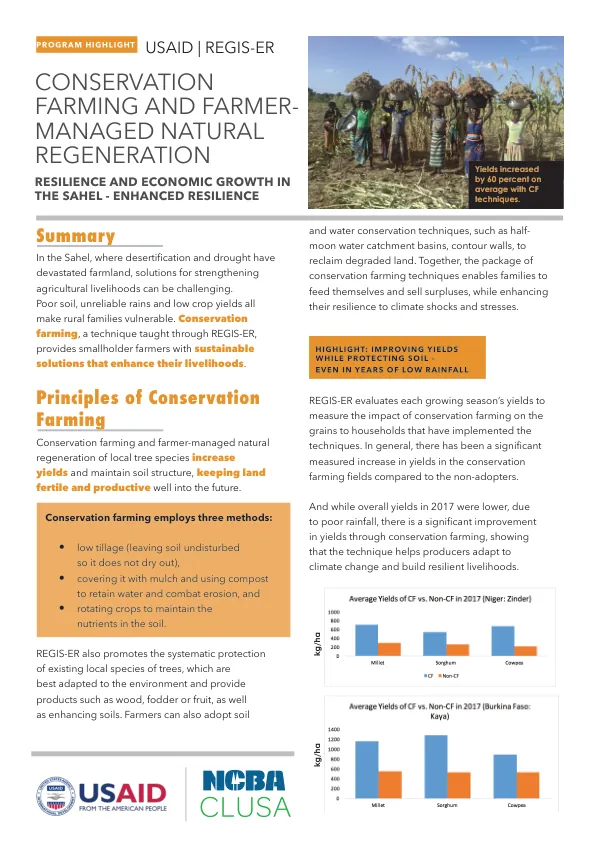
This approach increases yields and maintains soil structure, keeping land fertile and productive well into the future. Conservation farming employs three methods: low tillage, covering the soil with mulch and using compost to retain water and combat erosion, and rotating crops to maintain the nutrients in the soil. REGIS-ER, a program supported by USAID, promotes the systematic protection of existing local species of trees, which are best adapted to the environment and provide products such as wood, fodder, or fruit, as well as enhancing soils. Farmers can also adopt soil and water conservation techniques, such as half-moon water catchment basins and contour walls, to reclaim degraded land. Together, the package of conservation farming techniques enables families to feed themselves and sell surpluses, while enhancing their resilience to climate shocks and stresses. Yields have increased by 60 percent on average with conservation farming techniques. REGIS-ER evaluates each growing season's yields to measure the impact of conservation farming on the grains to households that have implemented the techniques. In general, there has been a significant measured increase in yields in the conservation farming fields compared to the non-adopters. Even in years of low rainfall, conservation farming has shown a significant improvement in yields, demonstrating its ability to help producers adapt to climate change and build resilient livelihoods. Innovations along the input supply chain have also been implemented to support conservation farming. REGIS-ER facilitated the establishment of a "CF input mechanism" to ensure a sustainable supply of NPK fertilizer. This mechanism links farmers, suppliers, and micro-finance institutions together to ensure timely procurement of inputs, delivered to communities. In 2017, REGIS-ER supported 277 farmer groups in Burkina Faso, with more than 3,800 producers, who procured over 150 tons of NPK fertilizer valued at 55.6 million CFA francs (around $100,000). The adoption of conservation farming has rapidly gained momentum in REGIS-ER targeted villages due to its immediate and tangible effects. The farming technique was disseminated through demonstration fields, farmer visits, and broadcast on local radio. At the community level, the technology is affordable through sharing and training and coaching through a lead farmer approach enables quick scale-up. The local government technical services are also involved in measuring yields. The network of agriculture community-based solution providers (CBSPs) played a key role in driving the mechanism by inventorying the fertilizer needs of the groups and linking to suppliers.