USAID
Resilience and Economic Growth in the Sahel – Enhanced Resilience (REGIS-ER)
The Enhanced Resilience (REGIS-ER) project is a 7-year initiative that aimed to increase the resilience of chronically vulnerable populations in marginal agro-pastoral areas in Burkina Faso and Niger.
2020 · 8 pages
Sign in to readA free account is required to download.
Abstract
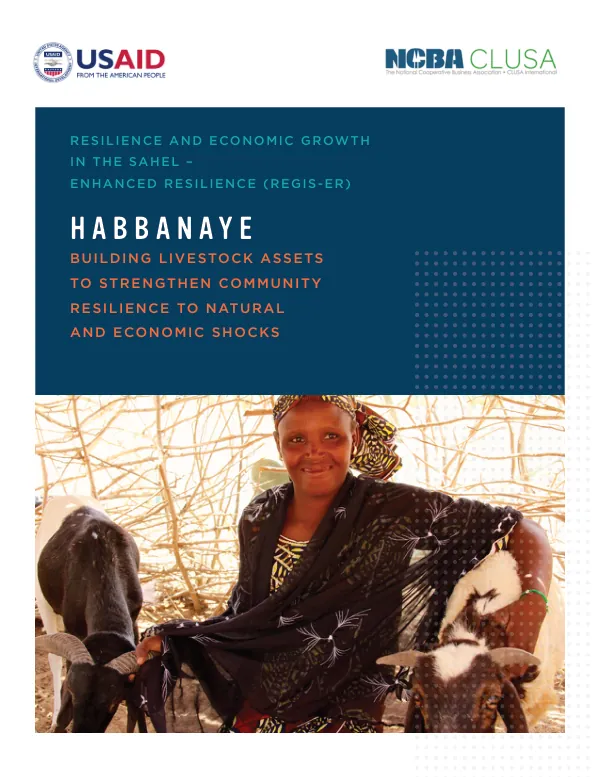
The project, supported by USAID for a total of $76 million, was an activity of the RISE portfolio and focused on building livestock assets to strengthen community resilience to natural and economic shocks. REGIS-ER worked in 6 regions, 25 municipalities, and 570 villages from November 2013 to November 2018. The project then entered a cost-extension phase, reducing its intervention area to eight municipalities in three regions of Burkina Faso and Niger. The project's main goal was to enhance the resilience of households, particularly those headed by women, through the habbanaye system. Habbanaye is a traditional Fulani system of solidarity that involves building or rebuilding productive capital in animal assets for needy members of a community. The system typically involves entrusting a female animal to a beneficiary, who cares for it and returns it to its owner after one or more reproductive cycles. The offspring are then reared by the beneficiary to provide milk and meat for the household or as a source of income to meet family needs. REGIS-ER adopted the habbanaye system as a key activity, introducing some variations to target and build assets among vulnerable households. The project initially focused exclusively on goats, which are highly valued for their robustness and fecundity. Communities identified the most vulnerable women in their midst as beneficiaries who would receive one male and three female goats, as well as training in raising goats and animal health services. In 2016, REGIS-ER introduced a major change to its targeting approach, making the members of its Mother-to-Mother groups the priority target group of the habbanaye activity. The project also added poultry habbanaye, which is suited for women who are homebound and offers a quicker reproductive cycle. The most important innovation occurred in early 2019, when the project increased the responsibilities of local authorities and civil society organizations, entrusting them with the management of habbanaye activities. The habbanaye system has proven to be an effective means of enhancing resilience in the Sahel. It improves the nutritional status of children who have access to milk and protein from meat and eggs. Households have assets or a source of income to deal with shocks, such as drought, economic difficulties, or personal ones, and recover more quickly. Habbanaye also facilitates inclusive economic growth and social inclusion of marginalized people, such as women and youth. To improve the feeding and fattening processes, REGIS-ER provided services and advice on best practices, particularly through the network of community-based solution providers. These last-mile veterinary agents connect farmers with animal health services and facilitate links to animal feed suppliers. Habbanaye helps communities prepare for and recover from chronic or sporadic shocks, breaking the cycle of humanitarian crisis and response. The implementation scheme of the habbanaye project involves four key steps: providing the initial gift, building the capacity of local organizations to lead and manage the habbanaye system, transferring animals to vulnerable households, and providing a source of security, income, and nutrition. The project's sustainability strategy focused on establishing a sustainable system managed by the commune-level Citizen Working Group (CWG) and Municipal Council, as well as community-level organizations. REGIS-ER has developed a habbanaye monitoring tool using Excel for CWGs to monitor animal placements and transfers, which provides a real-time situation by village. The tool, accompanied by training, coaching, and a habbanaye guide, was provided to CWGs to facilitate the implementation of the activity in collaboration with the CLDs/CVDs, which oversee the village monitoring committees. The habbanaye activity is now entirely co-managed by the Municipal Councils, CWGs, CLDs/CVDs, and the village monitoring committees. This locally managed system of habbanaye went into full effect on October 1, 2019, in the eight communes of intervention. Over the first six months of implementation of this sustainable model, the aforementioned local actors in the eight communes placed 864 goats with 216 beneficiaries and transferred 739 goats to 226 others. The overall life-of-project results achieved by REGIS-ER in its entire zone of intervention include the placement of 864 goats with 216 beneficiaries and the transfer of 739 goats to 226 others. The project's success story is exemplified by the case of the municipality of Sebba in Burkina Faso, where the local authorities have taken ownership of the habbanaye system, marking a key step towards its sustainability.