INDIAN INSTITUTE OF MANAGEMENT
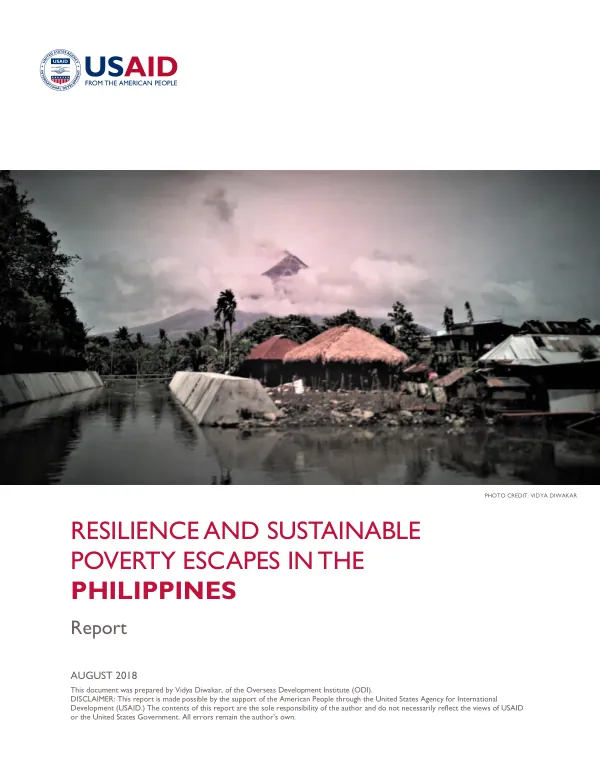
Resilience and Sustainable Poverty Escapes in the Philippines
The focus of this report is on resilience and household poverty escapes, with a specific emphasis on understanding why some households escape poverty and remain out of poverty, while others escape poverty only to fall back into it.
2018 · 42 pages
Sign in to readA free account is required to download.
Abstract
This case study finds that transitory poverty escapes and impoverishment are significant phenomena in the Philippines. The report is based on analysis from three rounds of the panel component of the Family Income and Expenditure Survey over 2003-2009, as well as qualitative research approaches, including key informant interviews, life histories, and participatory wealth ranking in two regions. Household resource base plays a crucial role in enabling households to escape poverty sustainably. Electricity has been identified as an enabler for households in their pathway out of poverty, with qualitative data suggesting that it is viewed as a 'fait accompli' due to its widespread coverage. In rural areas, livestock provides households with subsistence, a source of investment, and insurance in times of need. Household attributes, such as social capital, are also important in sustaining poverty escapes. Families without supportive networks are often amongst the most vulnerable, and feature strongly in cases of chronic poverty. Regression analysis indicates that an increase in household size by one member is associated with a reduced risk of impoverishment by 27%, reflecting the importance of productive income earners within intra-household networks. Women's empowerment is also an important component for sustained poverty escapes, with control of savings, household decision-making, and engagement in community-level politics and social programs being key indicators. In regression analysis, household heads who completed secondary education were less than half as likely to be chronically poor relative to escaping poverty sustainably. Household activities, such as salaried employment and self-employment in non-farm enterprises, have been successful routes out of poverty, particularly in urban areas. However, a lack of market access and high transportation costs often constrained agriculture wage labor and self-employment in agriculture from being a pathway out of poverty for the rural chronic poor. Household shocks, such as high-intensity typhoons, have a significant impact on poverty dynamics, with a greater presence of these disasters associated with over double the risk of impoverishment relative to a sustained escape from poverty. An increase in health spending is also associated with a higher risk of impoverishment, with health shocks being a common reason cited by households for falling back into poverty after escaping. The analysis shows that households' strategies for sustained poverty escapes center around social capital, which is instrumental in initially promoting escapes out of poverty, though not always a driver in the process of sustaining these escapes over time. Households sustain poverty escapes often through multiple income sources, and maintain resilience in the face of shocks as a result of this livelihood diversification or successfully assessing market demands. Non-farm enterprises and salaried employment have provided successful avenues out of poverty, with the latter preferred by some for its stable, steady income. The report highlights the importance of social capital in sustaining poverty escapes, with households that have larger family networks or social capital being more likely to escape poverty sustainably. However, households without these networks or social capital, often the chronically poor, remain largely excluded from the poverty reduction process. The report concludes by emphasizing the need for policies that support the development of social capital and promote livelihood diversification, in order to help households sustain poverty escapes and build resilience to shocks.