INSTITUTE FOR INTERNATIONAL DEVELOPMENT, INC.
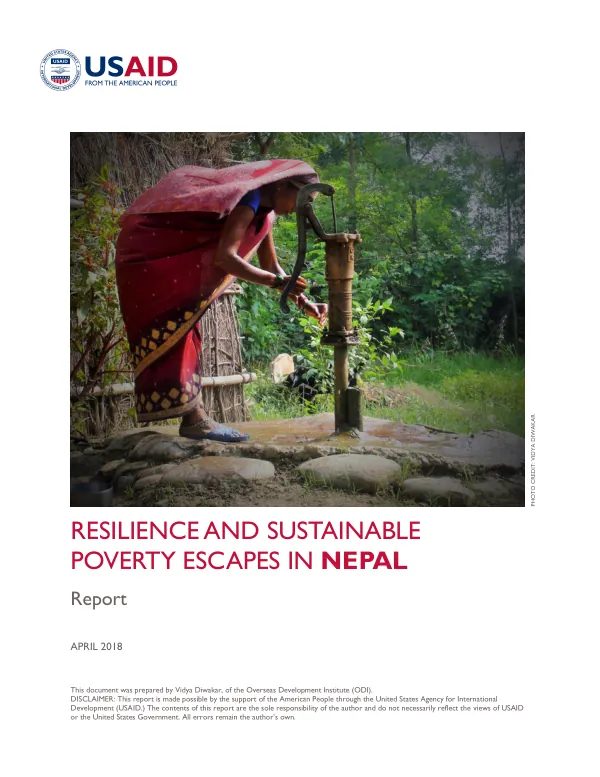
Resilience and Sustainable Poverty Escapes in Nepal
Nepal experienced considerable poverty reduction over the last two decades.
2018 · 45 pages
Sign in to readA free account is required to download.
Abstract
The country's poverty headcount reduced from 63.8% in 1995 to 30.8% in 2010, according to the 2010 national poverty line, and even lower to 25.2% in 2010 (Uematsu et al., 2016). The enablers of poverty reduction in Nepal have included an increase in migration and remittances, non-farm diversification, higher non-farm wages, and a decline in fertility rates (World Bank, 2016). However, over the same period, several factors including low economic and agricultural growth, weak public infrastructure, continued exclusion of disadvantaged groups, and conflict and other shocks prevented households from escaping poverty, or pushed households which had escaped back into poverty. The focus of this report is on household poverty escapes and what explains why some households escape poverty and remain out of poverty (sustainable poverty escape, or resilience), while other households escape poverty only to fall back into poverty (transitory poverty escape) and still other descend into poverty for the first time (impoverishment). Analysis of the Nepal Living Standards Survey (NLSS) for this case study reveals that transitory poverty escapes are a significant phenomenon in both rural and urban Nepal. Between 1995/96 and 2010/11, around 25% of households either escaped poverty only to fall back into poverty, or became impoverished over time (Figure 1). In urban areas, these rates were slightly higher (27%) compared to rural areas (24%), brought up by a particularly high rate of impoverishment (23%) in urban areas. This report combines analysis from three rounds of the panel component of NLSS with qualitative research approaches, in particular, key informant interviews, life histories, and participatory wealth ranking to further investigate the drivers of sustained and transitory poverty escapes and of impoverishment. The report investigates the resources (land, livestock, and value of assets), attributes (household composition and education level), and activities (including jobs and engagement in non-farm activities) of households that enable them to build their resilience to sustainably escape poverty and minimize the likelihood of them falling back into poverty or descending into poverty for the first time. Key findings suggest that in Nepal, the following factors contribute to sustainable poverty escapes: building the initial household resource base, improving household and personal attributes and capacities, and reducing the risks associated with single-source economic activities. Building assets are generally helpful in improving welfare, but in Nepal have been highly vulnerable to risks including conflict, theft, and fires. Livestock helps smooth consumption when other costs arise, and is particularly a beneficial source of income for households with productive members. Regression results indicate that larger households are less at risk of a poverty escape that is transitory rather than sustained. Improving household and personal attributes and capacities is also crucial for sustainable poverty escapes. Female headship due to widowhood, separation, or divorce can drive households back into poverty after they have escaped; on the other side, according to qualitative data, marriage alone may be insufficient in sustaining a poverty escape, especially where gendered norms curtail women’s agency. Reducing the risks associated with single-source economic activities is also essential for sustainable poverty escapes. According to qualitative data, engagement in agriculture can, in specific circumstances and for households with sufficient land, be a successful pathway out of poverty, particularly in instances where households have access to information about production technologies and quality inputs, where partnerships exist between husband and wife, where there is diversification (even within agriculture), and when linked with markets. Non-farm enterprises offer a particularly sustainable way out of poverty, especially for those with training and education. Controlling for other variables, regression results indicate that engagement in a non-farm enterprise reduces the risk of a poverty escape being transitory rather than sustained by the largest amount compared to other economic activities. However, lack of customers and capital problems constrain profitability for some households. Engagement in non-farm economic labor also has its risks. Fieldwork reveals that social connections in these settings continue to disadvantage marginalized social groups. Migration can under certain circumstances be a pathway out of poverty, particularly where skills learned through migration are used upon returning to Nepal. However, cases of indebtedness and social breakdowns through death and permanent illness often offset the benefits, and render migration a less reliable pathway out of poverty.
Related documents
Documents in this collection
 2018
2018USAID DEC
Feed the Future Knowledge-Based Integrated Sustainable Agriculture in Nepal (KISAN) II Project Year Two Second Trimester Report
Open record 2018
2018USAID DEC
Feed the Future Knowledge-Based Integrated Sustainable Agriculture in Nepal (KISAN) II Project Year Two First Trimester Report
Open record