FOOD FOR THE HUNGRY, INTERNATIONAL
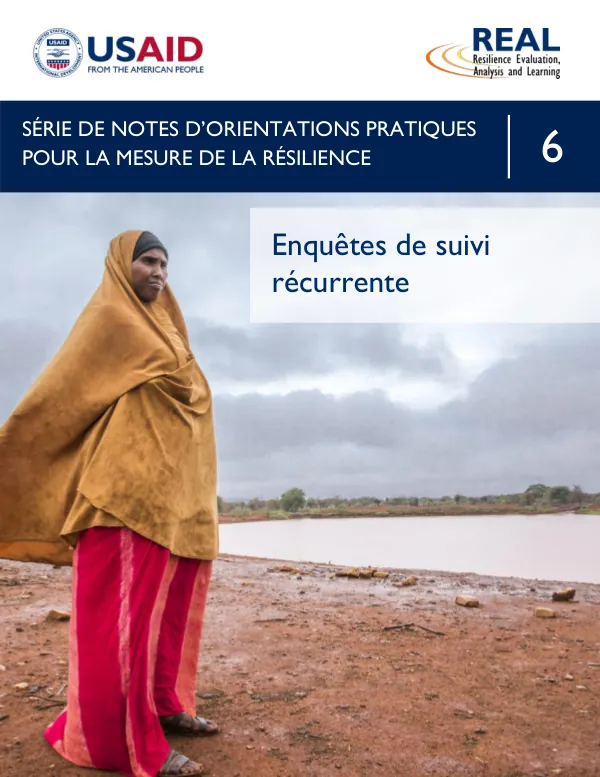
Guidance Note 6: Recurrent Monitoring Surveys
Resilience has emerged as a key concept in understanding and addressing the increasing complexity and magnitude of risk in humanitarian and development contexts.
2019 · 27 pages
Sign in to readA free account is required to download.
Abstract
The USAID Resilience Measurement Practical Guidance Note Series aims to provide new insights based on recent efforts to assess, analyze, monitor, and evaluate resilience. This guidance note, Recurrent Monitoring Surveys, is part of the series and focuses on measuring resilience at the individual, household, and community level. The USAID defines resilience as "the ability of people, households, communities, countries, and systems to mitigate, adapt to, and recover from shocks and stresses in a manner that reduces chronic vulnerability and facilitates inclusive growth." This definition describes the relationship between three distinct elements that form the basis of a resilience measurement framework: resilience capacities, shocks and stresses, and well-being outcomes. A key resilience measurement tool for capturing these dynamics is the recurrent monitoring survey (RMS). An RMS has several characteristics that distinguish it from a typical program monitoring system. It is focused on the relationship between commonly experienced shocks, responses, and changes in well-being in the project target area. Data collection is either triggered by a shock or is collected within specific intervals when shocks/stresses are likely to happen. The RMS surveys the same individuals and/or households over time, typically relying on a relatively smaller sample size. This approach allows for the capture of how individuals and households respond to the shock/stress and how this affects their well-being trajectories in the short and long-term. The RMS is a valuable tool for measuring resilience and has been used in various country and project contexts. Determining whether to deploy an RMS requires careful consideration of several factors, including the project's objectives, the target population, and the available resources. Methodological considerations for designing an RMS include defining the RMS information needs and objectives, identifying the shock/stress context, and selecting the appropriate intervention approach. Planning and budgeting for an RMS are also critical components of the process. This involves integrating the RMS into the Monitoring, Evaluation, and Learning (MEL) plan, hiring consultants or doing the RMS in-house, and budgeting for the RMS. The guidance note draws on examples from multiple country and project contexts to provide practical guidance on these considerations. The RMS has been used in various contexts, including the Pastoralist Areas Resilience Improvement and Market Expansion (PRIME) project, which was one of the first USAID projects to test out measuring resilience through real-time monitoring of capacities, responses, well-being outcomes, and shocks and stresses. The findings from this RMS made a significant impact on the international development community's understanding of resilience dynamics and how USAID's programming contributes to building resilience. In conclusion, the recurrent monitoring survey is a valuable tool for measuring resilience at the individual, household, and community level. It has several characteristics that distinguish it from a typical program monitoring system, including a focus on the relationship between commonly experienced shocks, responses, and changes in well-being. The guidance note provides practical guidance on determining whether to deploy an RMS, methodological considerations for designing an RMS, and planning and budgeting for an RMS.
Related documents