NORC AT THE UNIVERSITY OF CHICAGO
Resilient, Inclusive & Sustainable Environments (RISE) Challenge Policy Brief
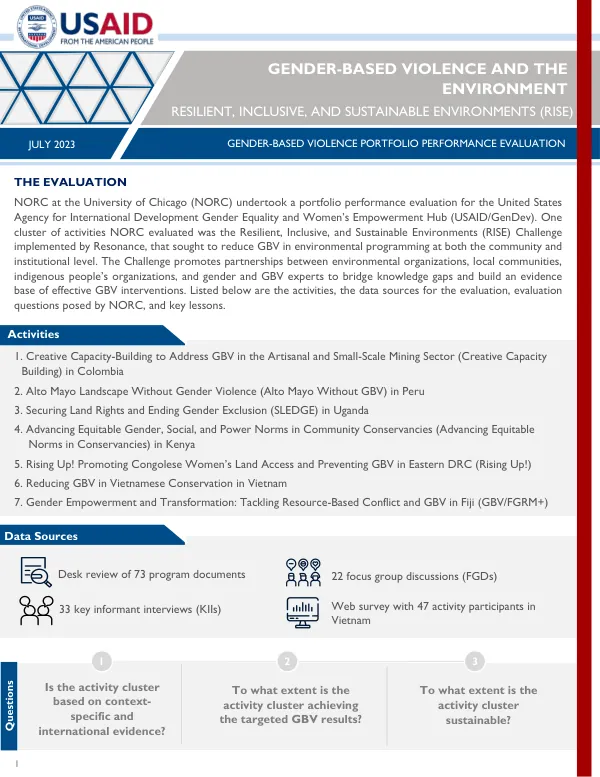
The Resilient, Inclusive, and Sustainable Environments (RISE) Challenge was a cluster of activities implemented by Resonance to reduce gender-based violence (GBV) in environmental programming at both the community and institutional levels.
2023 · 4 pages
Sign in to readA free account is required to download.
Abstract
The Challenge promoted partnerships between environmental organizations, local communities, indigenous people's organizations, and gender and GBV experts to bridge knowledge gaps and build an evidence base of effective GBV interventions. The RISE Challenge consisted of seven activities implemented in various countries, including Colombia, Peru, Uganda, Kenya, the Democratic Republic of Congo, Vietnam, and Fiji. These activities focused on addressing GBV in the artisanal and small-scale mining sector, conservation, and natural resource management. The activities aimed to promote gender equality, empower women, and prevent GBV through awareness-raising, capacity-building, and livelihood activities. The evaluation of the RISE Challenge was conducted by NORC at the University of Chicago, which assessed the portfolio performance of the activities. The evaluation aimed to determine the extent to which the activities achieved the targeted GBV results, were sustainable, and were based on context-specific and international evidence. The evaluation found that the activities were effective in raising awareness about GBV and promoting changes in attitudes and behaviors. However, the evaluation also identified several challenges, including limited time and funding to expand or entrench the activities in local practice, unanticipated local realities, and resistance from community members. The evaluation recommended that future iterations of the RISE Challenge should continue to utilize flexible and user-focused monitoring for intervention adaptations, conduct context-specific planning and design, and establish realistic objectives and measurable outcomes. The evaluation also highlighted the importance of combining awareness-raising with livelihood activities to spark behavioral change. Respondents emphasized that knowledge of their rights and new skills empowered them to push back when experiencing GBV, knowing they have other ways to generate income. The evaluation recommended that future community-targeted programs should continue to invest in collaboration between GBV and environmental programming. The RISE Challenge demonstrated the benefits of joint funding (environment and GBV), but it was beyond the scope of the program to produce robust data establishing causal linkages between GBV and climate change. The evaluation recommended that donors who plan to fund interventions to achieve institutional change and policy implementation should undertake a realistic feasibility assessment to determine what "successful implementation" looks like and what outcomes are achievable and measurable in the funding timeframe. The evaluation concluded that the RISE Challenge was a valuable initiative that contributed to the understanding of the intersection of GBV and the environment. The evaluation recommended that future iterations of the RISE Challenge should continue to integrate context-specific planning and design, utilize flexible and user-focused monitoring, and establish realistic objectives and measurable outcomes.