USAID DEC
Resources to Improve Food Security in Eastern Democratic Republic of the Congo (RISE)
Sign inCARITAS INTERNATIONAL
Resources to Improve Food Security in Eastern Democratic Republic of the Congo (RISE)
The RISE program in the Democratic Republic of the Congo aims to improve food security among vulnerable households and communities in North Kivu.
2014 · 30 pages
Sign in to readA free account is required to download.
Abstract
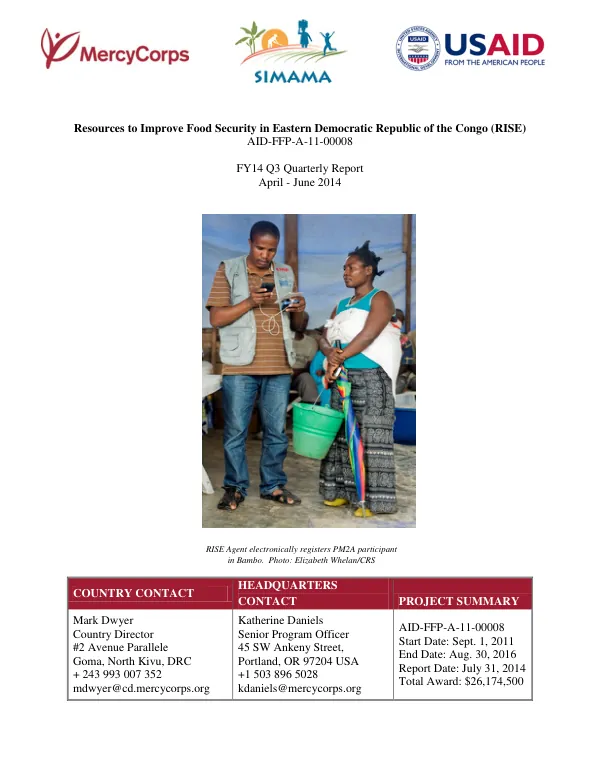
The program focuses on agricultural production, crop disease control, household income increase, and childhood malnutrition prevention. Activities address challenges related to food availability, access, and utilization. RISE aims to build communities' resilience to shocks by introducing sustainable household coping mechanisms and encouraging market engagement. Implementation of the program involves three sectors: SO1, SO2, and SO3. SO1 focuses on smallholder farming households, increasing and diversifying production and profit. The agriculture team strengthened seed supply, organized producer groups, and disseminated information on agricultural practices. Distribution of 488 breeding rabbits to 122 households and formation of 80 new producer groups were key activities. Additionally, 214 savings groups were formed, and 20 Village Agents received capacity-building training. SO2 targets 31,292 participants of the Preventing Malnutrition in Children under 2 Approach (PM2A). Joint supervision visits to health centers with Health Zone staff were conducted to monitor healthcare quality and identify areas for improvement. Piloting Information Communication Technology for Development (ICT4D) for registering PM2A participants was also implemented. Capacity building of health service providers, RECOs, and Mother Leaders on Essential Nutrition Actions (ENA) was completed. SO3 focused on revitalizing Community Development Committees, in collaboration with the Ministry of Decentralization. Capacity building for local authorities, civil society, CDCs, and other stakeholders on decentralization and local development plan elaboration was conducted. Supporting associations on organizational management and training for communities on disaster risk reduction (DRR) management were also key activities. Forty-six out of 60 targeted Food for Work (FFW) micro projects were implemented, providing work for 380 people. Behavior change communication activities supported all SOs through the development and launch of radio spots to promote ENA, agriculture, and governance messages. Mother Leaders formed Mother's Groups and became more engaged in BCC activities. The BCC and nutrition teams carried out the year's 2nd nutrition Lot Quality Assurance Sampling (LQAS) survey. Internal and external coordination were improved in response to the mid-term evaluation (MTE) recommendations. Meetings were conducted to improve coordination between implementing agencies and with the local government. A MTE planning workshop was held to elaborate an action plan, and meetings were conducted with USAID-FFP to discuss the proposed post-MTE action plan and revised results framework. Externally, meetings were held to strengthen collaboration with key stakeholders, including value chain actors, the Commission for Destruction of Commodities, and the Food Security Advisor for Norwegian Refugee Council. The RISE agriculture field staff attended Food Security Cluster meetings, and the RISE nutrition team participated in UN Nutrition Cluster meetings.