MERCY CORPS INTERNATIONAL
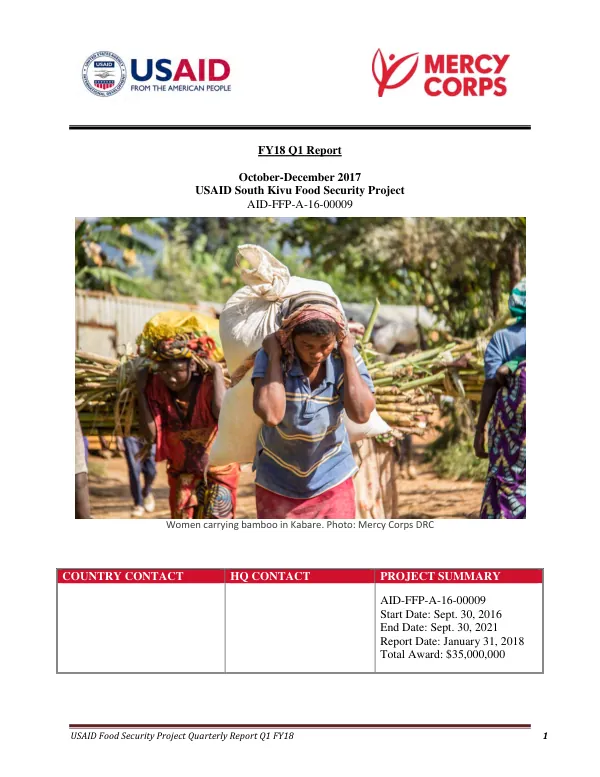
USAID Food Security Project Quarterly Report Q1 FY18
The USAID South Kivu Food Security Project, a five-year initiative, began on September 30, 2016, and is set to conclude on September 30, 2021.
2018 · 11 pages
Sign in to readA free account is required to download.
Abstract
The project, implemented by Mercy Corps in partnership with World Vision, Harvest Plus, the Université Evangélique en Afrique (UEA), and Action pour la Paix et la Concorde (APC), aims to improve the food and nutrition security and economic well-being of approximately 35,000 households or 210,000 people in the Democratic Republic of the Congo (DRC). The project's objectives are aligned with USAID's strategic objectives for the DRC, focusing on increasing income through on- and off-farm livelihoods, improving health and nutrition practices and services, and promoting good governance and a more stable operating environment. To achieve these objectives, the project will work with households, community leaders, the government of DRC, and other development programs. During the first quarter of Fiscal Year 2018 (October-December 2017), the project team continued to finalize activities related to the Refine year, finalizing most of the Research and Innovation (R&I) assessments reports, submitting the final report of the Strategic Resilience Assessment (STRESS) process, and participating in the R&I and USAID Monitoring and Evaluation (M&E) workshops. The project staff also took part in the USAID Food Commodities Management training in Goma and organized a visit and inspection of the commodities warehouse space for USAID representatives. The project's staff recruitment process was also ongoing during this quarter, with the recruitment of a new DCOP position, a Gender and Youth Advisor, and a Health and Nutrition Project Manager. The project has made significant progress in filling vacant positions, with some positions still pending, including M&E, WaSH, and health. The project's Initial Environment Examination (IEE) was approved on December 4, 2017, with five conditions to be fulfilled by January 1, 2018. The project submitted its replies to the five conditions in December and will follow through on the conditions in the planning and implementation of activities starting in the second quarter of Fiscal Year 2018. The project also submitted a revised concept note on December 15, 2017, to increase the sustainable impact of the project by developing and enhancing activities around two key themes: empowering women and youth through literacy, and building community resilience through improved natural resources management. The project's procurement of vehicles was initiated during the third quarter of Fiscal Year 2017, with the chosen supplier being Toyota Gibraltar. The vehicles were delivered in DRC at the end of November 2017 and are currently in the process of registration to obtain IT plate numbers. The project's field bases in Kavumu, Katana, and Kalehe were set up and have been operational since the end of the first quarter of Fiscal Year 2018. The project continued to build its relationship with key stakeholders and government ministries while gaining a deeper understanding of community dynamics. In the absence of an approved Initial Environmental Examination, the program team focused its initial program activities on community mobilization, beneficiary identification, and communication of program strategies and goals. The project's coordination efforts are taking place between World Vision and Mercy Corps staff to further clarify both strategies and approaches. Some of this discussion involves the consortium's senior management teams to validate and approve technical strategic documents for quality and coherence. These documents include Strategies for Purposes 1, 2, and 3, Gender, Youth, and SBCC. Manuals are being developed for FFS, Care Groups, Environmental Screening forms, commodities guidelines, and other components or procedures. The data collection tools are being designed taking the SBCC, environmental compliance, and gender and youth aspects into account before deploying staff into villages to collect data for all three purpose objectives. The project's Purpose 1 team held the first meeting of a Technical Working Group with World Vision P1 staff, the COP, and the Program Quality Manager to review the main challenges and begin planning the activities for the next quarter. Farmer Field Schools were set up per health area, with each FFS having 25 participants, selected from the most vulnerable households in the area. The FFSs are supplied with a variety of vegetable seeds, and the households will receive theoretical and practical lessons in the fields planned for the FFSs. These trainings will be provided by the project's agricultural team.
Related documents