CARITAS INTERNATIONAL
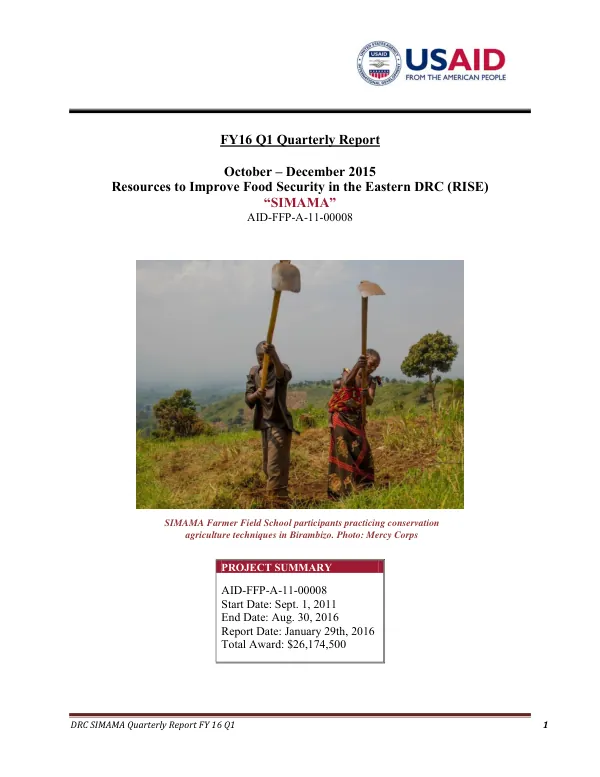
DRC SIMAMA Quarterly Report FY 16 Q1
The SIMAMA program, implemented by Mercy Corps in partnership with Catholic Relief Services (CRS), aims to improve food security in North Kivu, Democratic Republic of Congo.
2016 · 30 pages
Sign in to readA free account is required to download.
Abstract
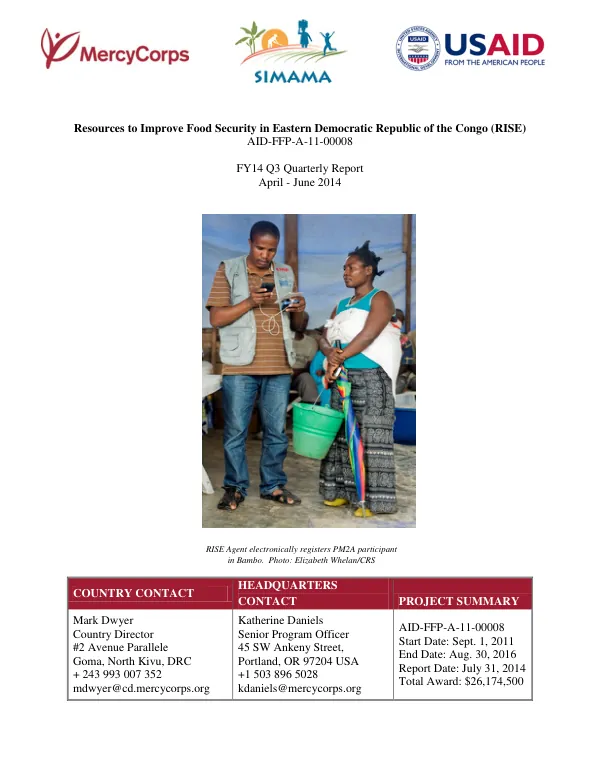
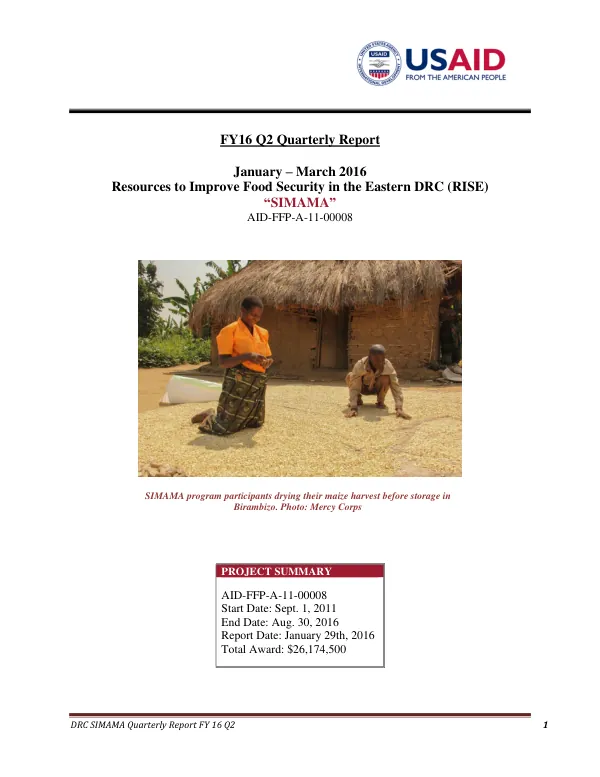
The program focuses on agricultural production, disease control, household income, and childhood nutrition. Activities address challenges related to food availability, access, and utilization, with a goal of building community resilience to shocks. During the period of October to December 2015, the program achieved sound results, particularly within the agriculture component. The planting season coincided with the reporting period, allowing for intensive activity implementation. The Health and Nutrition component and Governance component carried out their activities according to detailed implementation plans. The program's exit strategy was underway, with SIMAMA submitting its FY15 Annual Report to FFP and mainstreaming the exit strategy in each Strategic Objective. Key obstacles to sustainability included lack of leadership and resources for governmental offices, limited trust in community leaders, and prevailing insecurity in the Rutshuru territory. To mitigate these risks, SIMAMA invested in social and human capital development, focusing on community-driven approaches and decentralized administration. SIMAMA conducted a review of its human resources plan to anticipate staff notification on contract termination. Staff phasing down will start gradually at the end of March 2016. The food commodity pipeline was revised to ensure all distributions are completed by April 2016. A comprehensive Close Out Plan will be prepared and submitted to FFP by the end of February 2016. The PM2A fraud case investigation was finalized, and the disallowance process is underway. Only 50% of the SIMAMA year 5 budget has been approved, affecting program staff motivation due to quarterly employment contract renewals. Security remains stable in Butembo, but the program faces challenges in Birambizo. The Katwe base closed preemptively in mid-December to limit aggression risks during the holiday period. Activities resumed on January 5th, 2016. Strategic Objective 1: Agriculture and Livelihoods, focused on preparing fields and seeds during the rain season. SIMAMA supported Farmers Field Schools (FFS) and Common Interest Groups (CIG) with seed supplies, revitalizing their activities and allowing for training courses for 4,675 farmers engaged in market production and 1,900 farmers engaged in commercialization. The FFS market production groups created in FY15 were revitalized, with an important mobilization of new farmers, particularly from the SO2 component of Birambizo and Butembo. The level of participation of women was stable at 63%. The program provided seeds to FFS members, and farmers are confident that the awaited harvest will be of good quality and in high quantity. SIMAMA continued its efforts in agricultural technical training, with members of the FFS receiving training in planning and digging beds, choosing suitable land, conservation agriculture, and the production of biofertilizers. The curricula developed during FY15 were refined and translated into Swahili. Regarding BXW and Cassava Mozaic Disease, the FFS continued to share information on the fight against these crop diseases. SIMAMA adopted the village campaign approach, mobilizing the Government Chefferie of agriculture and management staff to sensitize every village within the Chefferie to adopt the methodology of fighting the diseases. A similar campaign was conducted in the Bwito Chefferie, which set up 200 groups fighting against BXW. The program increased the production of disease-tolerant seed varieties, with participating farmers' associations multiplying seeds of disease-resistant banana, cassava, maize, and soy. SIMAMA continued the dissemination of improved seed varieties, giving priority to SO2 participant families but also opening up to other interested families for a wider reach and optimal use of resources.
Related documents