USAID DEC
Review Moving forward with strengthening routine immunization delivery as part of measles and rubella elimination activities
Sign inJOHN SNOW INTERNATIONAL
Review Moving forward with strengthening routine immunization delivery as part of measles and rubella elimination activities
The Global Vaccine Action Plan (GVAP) was endorsed by the World Health Assembly in May 2012, validating several existing initiatives in immunization.
2013 · 7 pages
Sign in to readA free account is required to download.
Abstract
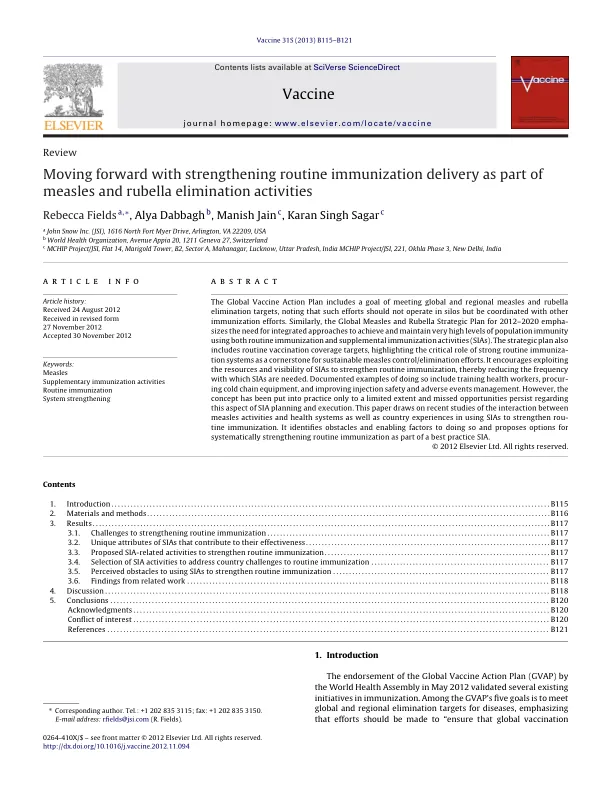
The GVAP's five goals include meeting global and regional elimination targets for diseases, emphasizing the need to ensure that global vaccination programs focused on eradication and elimination goals do not operate in silos. The GVAP further states that the specific mechanisms by which interaction and coordination among programs can be promoted vary by local contexts. The endorsement of the GVAP closely followed the release in April 2012 of the Global Measles and Rubella Strategic Plan for 2012-2020 by the Measles and Rubella Initiative (MR Initiative). This plan lays out goals and milestones for achieving measles and rubella elimination in at least five of the six World Health Organization (WHO) regions by 2020. The first of the five core components of the strategy is to achieve and maintain high levels of population immunity by providing high vaccination coverage with two doses of measles- and rubella-containing vaccines. Consistent with the GVAP, the Global Measles and Rubella Strategic Plan situates measles elimination within the broader health system context. Its guiding principles include using measles elimination activities, including supplemental immunization activities (SIAs), to strengthen routine immunization and equitably provide other proven health interventions to a wide target group. The Strategic Plan points out that SIAs can and should help strengthen routine immunization systems through renewed attention to core components of program management such as microplanning, health worker training, and reinforcement of the cold chain. In theory and in practice, this approach to measles elimination confers mutual benefits. In 2008 alone, measles SIAs in 17 African countries provided over 57 million doses of vitamin A supplements, 24 million doses of deworming medication, and 3.4 million insecticide-treated nets, thereby supporting other health interventions. The Global Measles and Rubella Strategic Plan emphasizes the need to integrate measles elimination activities with other health interventions to achieve broader health benefits. The plan also highlights the importance of strengthening routine immunization systems as a cornerstone for sustainable measles control and elimination efforts. This includes using SIAs to improve routine immunization coverage, particularly in areas with low coverage. The plan encourages countries to exploit the resources and visibility of SIAs to strengthen routine immunization, thereby reducing the frequency with which SIAs are needed. Documented examples of doing so include training health workers, procuring cold chain equipment, and improving injection safety and adverse events management. However, the concept has been put into practice only to a limited extent, and missed opportunities persist regarding this aspect of SIA planning and execution. This paper draws on recent studies of the interaction between measles activities and health systems as well as country experiences in using SIAs to strengthen routine immunization. It identifies obstacles and enabling factors to doing so and proposes options for systematically strengthening routine immunization as part of a best practice SIA.