USAID DEC
Review of Food Security Strategies and their Link with Conservation in AWF Selected Landscapes in Southern and Central Africa
Sign inAFRICAN BIODIVERSITY COLLABORATIVE GROUP
Review of Food Security Strategies and their Link with Conservation in AWF Selected Landscapes in Southern and Central Africa
The agricultural development initiative in southern and central Africa aims to enhance sustainable food security strategies through diversification of the rural economy.
2012 · 3 pages
Sign in to readA free account is required to download.
Abstract
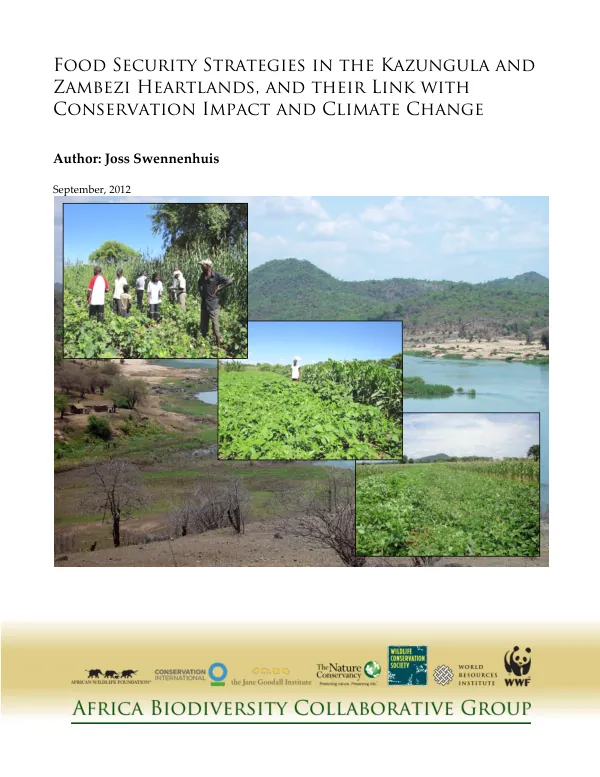
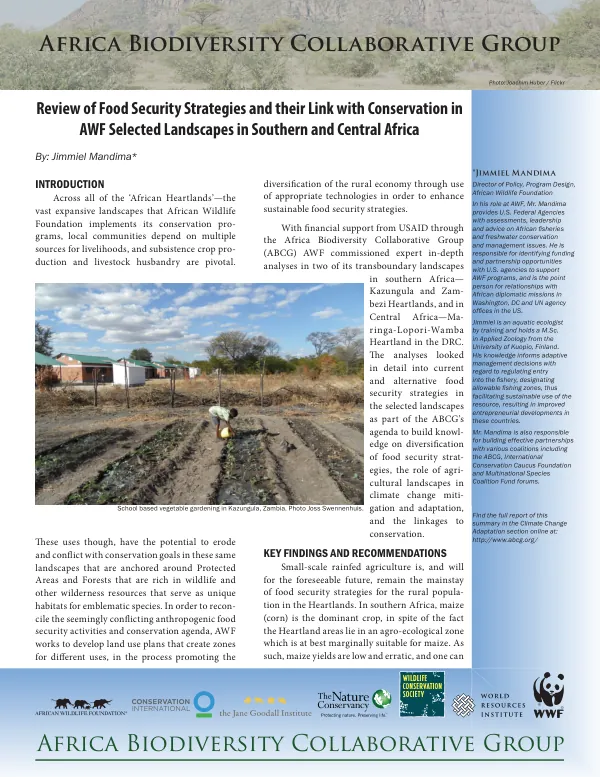
With financial support from USAID through the Africa Biodiversity Collaborative Group (ABCG), the African Wildlife Foundation (AWF) commissioned expert analyses in two transboundary landscapes in southern Africa—Kazungula and Zambezi Heartlands—and in central Africa—Maringa-Lopori-Wamba Heartland in the DRC. The analyses focused on current and alternative food security strategies in the selected landscapes as part of the ABCG's agenda to build knowledge on diversification of food security strategies, the role of agricultural landscapes in climate change mitigation and adaptation, and the linkages to conservation. Small-scale rainfed agriculture is the mainstay of food security strategies for the rural population in the Heartlands. In southern Africa, maize is the dominant crop, despite the fact that the Heartland areas lie in an agro-ecological zone that is marginally suitable for maize. Maize yields are low and erratic, and households are forced to continuously open up new fields, leading to degradation of forest resources and human-wildlife conflicts. In the DRC, cassava remains the main crop produced as staple, but the local people generally live off the fields produce, bushmeat hunting, small livestock, gathering, and fishing. The greatest potential for conservation and food security impact is through promoting more sustainable and intensive agricultural practices that would increase yields per hectare and maintain or increase soil fertility levels. Interventions should be long-term and holistic, avoid dependency on subsidized inputs, and promote synergies with climate mitigation and related financing options. To maximize conservation benefits, the interventions should take place within the context of an explicit land use framework and conservation agreements. AWF's current pilot aquaculture project in the Zambezi River has great potential and should be scaled up and replicated in other appropriate sites. Inadequate harmonization of transboundary fisheries management will remain a challenge that requires continued efforts on the part of AWF and others. The widespread, destructive, and largely illegal charcoal production is a very challenging threat to conservation, and recommended options to explore include the promotion of more sustainable charcoal production models, planting woodlots for charcoal, and explicitly targeting current charcoal producers as beneficiaries for interventions in alternative livelihoods. Human-wildlife conflicts will continue to exist in the Heartlands, but can be reduced through support for food security diversification that includes fish farming and horticulture activities that can be secured by investments in elephant-proof fencing. Additionally, fish farming and horticulture are good approaches that increase the resilience of households against climate change. Rainfed agriculture will become more resilient with the adoption of conservation agriculture techniques and crop diversification that includes drought-tolerant crops like cassava and flood-tolerant crops like the NERICA variety of rice. Options for climate mitigation finance within rainfed agriculture are expected to increase, in particular through promotion of sustainable land management practices that include agro-forestry. AWF's approach of promoting nature-based community enterprises has potential for significant food security impact in the medium to long term, as the success depends on a difficult-to-guarantee change in attitude of the local people towards coexistence with wildlife. However, as such enterprises deliver on benefits and create attitude and behavioral changes, the resultant conservation leverage would be substantial.