FHI 360
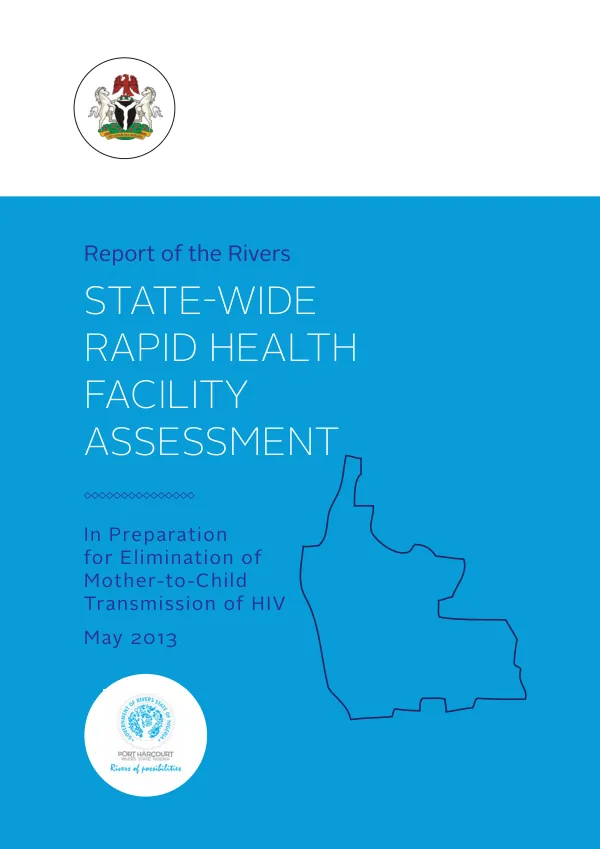
Rivers State-wide Rapid Health Facility Assessment
In Preparation for Elimination of Mother-to-Child Transmission of HIV, the Rivers State Ministry of Health conducted a statewide rapid health facility assessment in 2013.
2013 · 50 pages
Sign in to readA free account is required to download.
Abstract
The assessment aimed to identify gaps in the provision of Prevention of Mother-to-Child Transmission (PMTCT) services and to inform strategies for improving access to these services. The assessment was conducted in collaboration with FHI 360, with financial support from the U.S. Agency for International Development (USAID). The study tool used for the assessment included a facility survey, which collected data on facility ownership, human resources, and service utilization. The assessment also collected qualitative data through interviews with healthcare providers and facility managers. The assessment found that the majority of health facilities in Rivers State provided antenatal care (ANC) services, but only a small proportion of these facilities provided PMTCT services. The study identified a significant gap in the provision of PMTCT services, particularly in rural areas. The assessment also found that human resources, including doctors and nurses, were a major constraint to the provision of PMTCT services. The assessment revealed that facilities providing ANC with no PMTCT ARV support were more common in rural areas, and that human resources and service utilization varied significantly across different levels of facilities. The study also found that community delivery options, such as home-based care and community-based care, were preferred by respondents. The assessment identified several challenges to the provision of PMTCT services, including human resource gaps, inadequate infrastructure, and limited access to antiretroviral therapy (ART). The study recommended that the Rivers State Ministry of Health prioritize the strengthening of human resources, particularly in rural areas, and improve access to ART and other essential medicines. The assessment also recommended that the state government consider scaling up PMTCT services to reach more women and children, particularly in rural areas. The study suggested that community-based care and home-based care could be effective strategies for improving access to PMTCT services in rural areas. The assessment used geospatial representation to map the distribution of health facilities providing PMTCT services, as well as facilities that met national and state-defined human resource criteria for PMTCT services. The maps showed that there were significant gaps in the provision of PMTCT services, particularly in rural areas. The assessment concluded that the elimination of mother-to-child transmission of HIV in Rivers State would require a comprehensive approach that addresses the gaps in the provision of PMTCT services, improves access to ART and other essential medicines, and strengthens human resources. The study recommended that the state government prioritize the implementation of these strategies to achieve the goal of eliminating mother-to-child transmission of HIV in Rivers State. The assessment identified several key recommendations for improving access to PMTCT services, including: * Strengthening human resources, particularly in rural areas * Improving access to ART and other essential medicines * Scaling up PMTCT services to reach more women and children, particularly in rural areas * Implementing community-based care and home-based care strategies * Improving infrastructure and equipment in health facilities The assessment provided a comprehensive overview of the gaps in the provision of PMTCT services in Rivers State and identified key strategies for improving access to these services. The study's recommendations provide a roadmap for the state government to achieve the goal of eliminating mother-to-child transmission of HIV in Rivers State.