CATHOLIC RELIEF SERVICES ORGANIZATION
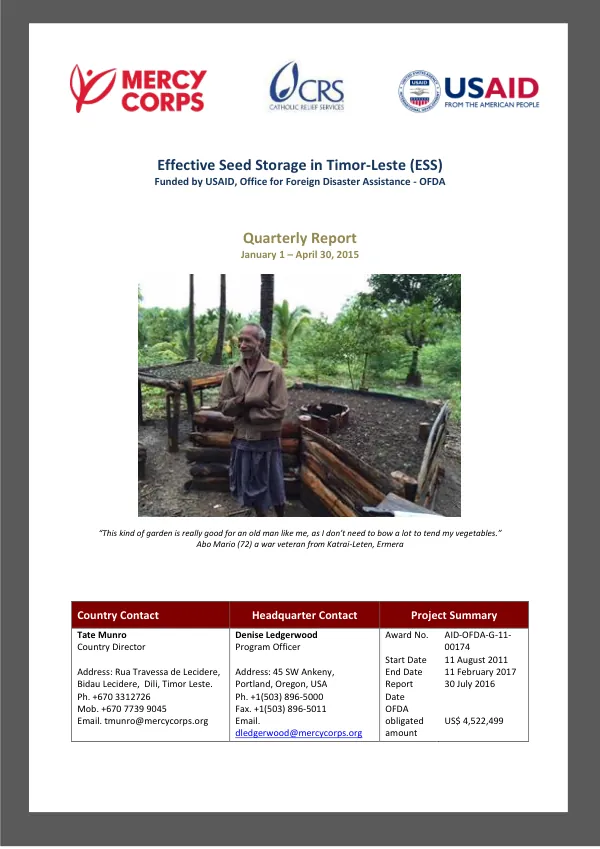
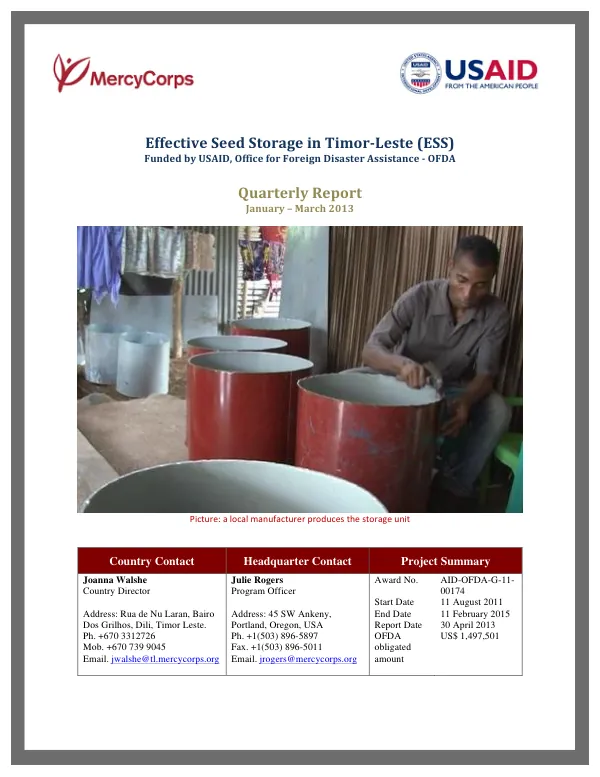
Quarterly Report – Effective Seed Storage in Timor-Leste
The agricultural sector in rural Timor-Leste is heavily reliant on subsistence farming, with the majority of farmers struggling with post-harvest seed loss due to inadequate storage facilities and poor seed quality.
2015 · 7 pages
Sign in to readA free account is required to download.
Abstract
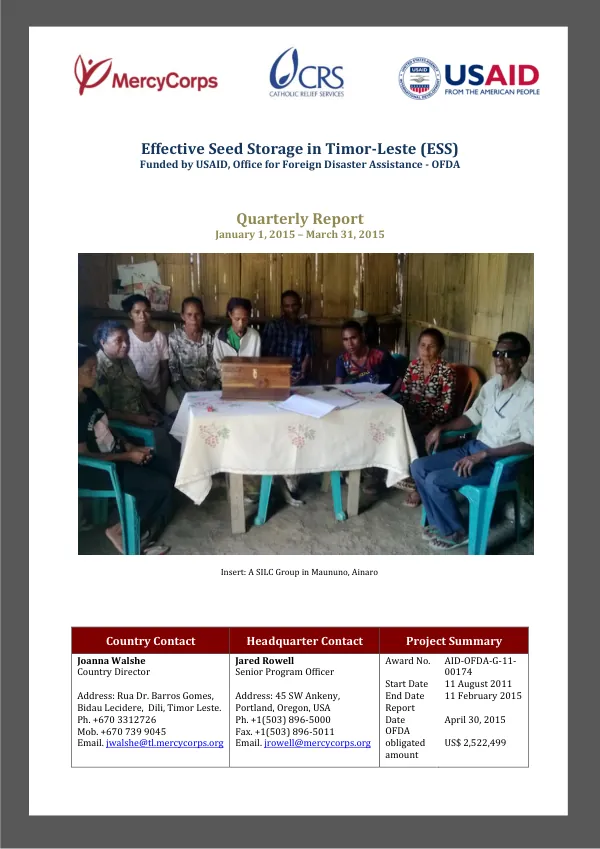
This issue is exacerbated by climate change, low soil fertility, limited access to water, and a lack of livelihood diversification. To address these challenges, the USAID/OFDA-funded Effective Seed Storage (ESS) program was implemented in 2011 to promote sustainable post-harvest protection of seeds and grain stocks. The program's innovative market-based approach focuses on increasing access to improved storage systems, capacity building of farmers and extension workers, and connecting farmers with viable input and output markets. Through partnerships with local NGOs and Catholic Relief Services, the program has successfully developed a market system for a metal-based seed storage system that is customized and locally manufactured. The expansion of the program has targeted neighboring districts and sub-districts, incorporating a Savings and Internal Lending Communities (SILC) component to provide savings-led financial services to poor farming households. As of March 2015, the program has reached 263,971 beneficiaries, with 40,000 farmers accessing improved seed storage systems, including silos and GrainPro bags. The program has also achieved significant reductions in post-harvest losses, with 93% of improved variety growers reporting decreased losses and 80% reduction in losses for other varieties. Additionally, the program has increased the availability of quality seed during planting seasons, with a 39% reduction in losses for improved seeds and 23.9% reduction for local varieties. The program's SILC component has also shown promising results, with 777 people newly receiving financial services, including 52% female beneficiaries. The program has also formed 46 groups, with 92% of financial service accounts functioning properly. The program's total USD amount channeled into the program area through sub-sector activities is zero, as the program has completed its implementation phase. The program's sector summary highlights the importance of behavior change communication (BCC) and training materials in promoting positive behaviors among program participants. The program conducted a DBC analysis on three behaviors: drying practice, seed selection process, and storage of seeds. The analysis identified key determinants of behavior change and informed the development of improved BCC and training materials. The program's focus on BCC and training materials has been instrumental in promoting the adoption of improved seed storage practices among farmers. The program's geographic area of focus includes at least 10 out of 13 districts of Timor-Leste, with a focus on rural areas where subsistence farming is prevalent. The program's implementation period has been from January 1, 2015, to March 31, 2015, with a focus on conducting the final evaluation and continuing SILC-related activities. The program's overall objective is to promote sustainable post-harvest protection of seeds and grain stocks, improving crop production and livelihoods in rural Timor-Leste.