CATHOLIC RELIEF SERVICES ORGANIZATION
Quarterly Report – Effective Seed Storage in Timor-Leste
The Effective Seed Storage in Timor-Leste (ESS) program is a market system for a metal-based seed storage system that is customized and locally manufactured.
2016 · 7 pages
Sign in to readA free account is required to download.
Abstract
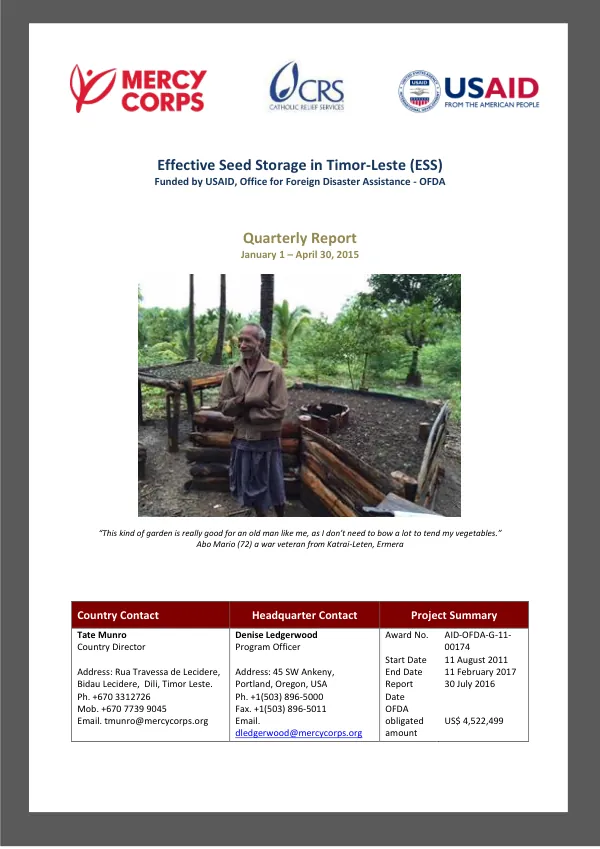
The program is designed to address seed system insecurity and ultimately food insecurity in Timor-Leste. Since August 2011, Mercy Corps and partners have successfully developed the market system, which has been replicated in 10 out of 13 districts in the country. The program incorporates a member-based financial institution model called Savings and Internal Lending Communities (SILC) to expand access to credit and promote a culture of savings among poor farming households. SILC membership provides savings-led financial services to communities that have little or no access to formal financial services, contributing to strengthening resilience among vulnerable families. In April 2015, Mercy Corps, its partner, Catholic Relief Services (CRS), and five local NGOs, along with at least 22 private businesses, worked to leverage the success of the program by expanding the improved storage system and SILC activities to further 'off-grid' communities and promoting keyhole gardening as a diversified production system, with a special focus on vegetable production. The expansion of SILC and seed storage activities are targeting underserved communities within the existing target and neighboring districts/sub-districts. The program has achieved significant progress in increasing food self-sufficiency, with a 27% increase in household income among program participants compared to the control group. The program has also increased the number of people benefiting from seed systems/agricultural input activities, with 301,396 beneficiaries reached, representing 46% female. In the sector of Economic Recovery and Market Systems, the program has focused on increasing resilience through access to credit and promoting a culture of savings. The program has reached 2,856 beneficiaries, with 49% women, and has achieved 100% of reported SILC groups functioning properly. The program has also increased the average amount of household income, with a 30% increase from the baseline. During the reporting period from April through June 2016, the program continued implementing activities related to improved seed storage systems, keyhole garden promotion, and providing capacity building to SILC groups. The ESS team assisted in a Market & Seed System Assessment, which is a follow-up assessment to the El Niño assessment reported in the previous Quarterly Report. The program has reached communities in 78 least-developed sucos across Timor-Leste, and has distributed additional 3,375 new seed storage voucher beneficiaries, bringing the total number of voucher recipients under the seed system storage component to 8,713 for the current phase.