GOVERNMENT OF COLOMBIA
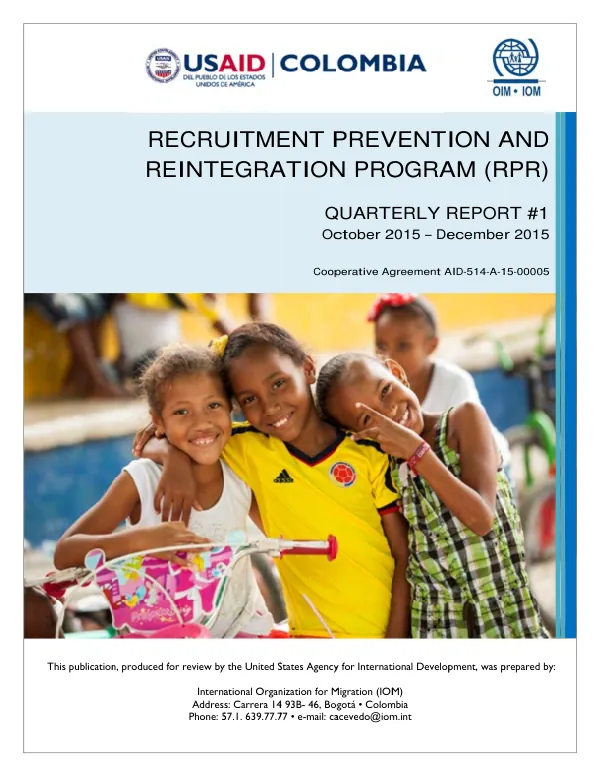
RPP PROGRAM - QUARTERLY REPORT
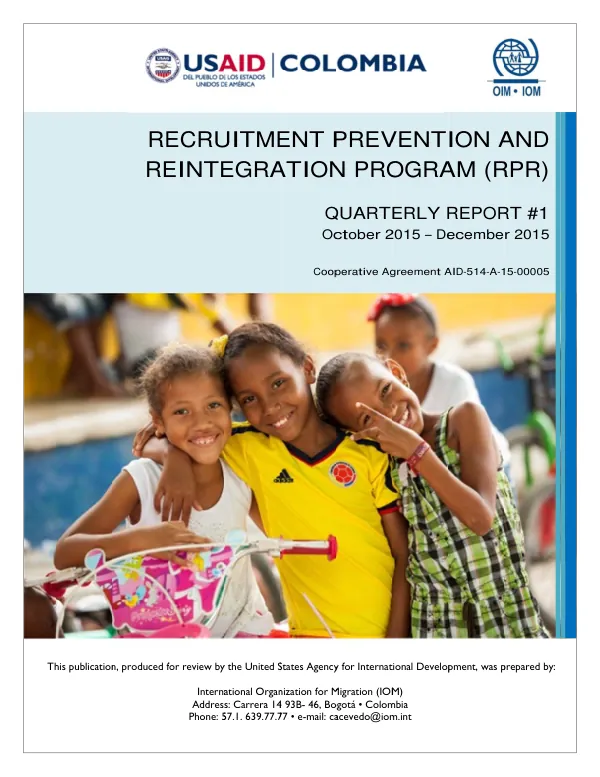
The Recruitment Prevention and Reintegration (RPR) program, implemented by the International Organization for Migration (IOM) in collaboration with the Government of Colombia (GOC), aims to support the GOC in fostering sustainable and inclusive reintegration for ex-combatants and disengaged children, and prevent further recruitment.
2015 · 11 pages
Sign in to readA free account is required to download.
Abstract
The program's strategic objective is to contribute to the achievement of this goal through four result areas: Roll-out, Prevention, Reintegration, and Coordination and Communication. The RPR program's Roll-out result area focuses on providing strategic technical assistance to support the early reintegration efforts of the GOC during the demobilization roll-out phase. This includes support to national and/or international verification initiatives. The Prevention result area aims to support the GOC in implementing strategies for the prevention of recruitment of children and re-recruitment of adults and children in conflict-affected areas. This includes linking services of the Colombian Institute for Family Welfare (ICBF) and the Colombian Agency for Reintegration (ACR) to private sector initiatives in rural and urban areas. The Reintegration result area seeks to support GOC efforts to advance legal processing and service delivery to ex-combatants and disengaged children in rural and urban conflict areas in a participatory, tailored, and community-focused manner. The Coordination and Communication result area aims to support GOC knowledge management, information systems, and communication efforts to clarify the judicial status of ex-combatants, with special emphasis on reintegration processes. During the first quarter of the program implementation period, October 2015 to December 2015, significant progress was achieved despite various uncertainties impacting RPR planning processes. Consultations were undertaken by the RPR team with all central government partners and over 40 stakeholders in the eight prioritized departments. This process fed into the development of the First Year Implementation Plan and the initial versions of Departmental Profiles. The RPR team presented the new program and gathered inputs from each partner on their perspectives on conflict dynamics, their priorities in the next year, and their identified needs for support and assistance. In Bogota, RPR met with key stakeholders, including the Ministry of Defense, the Ministry of Interior, and the Ministry of Justice and Law. The peace negotiations between the GOC and the FARC continued, with a preliminary transitional justice agreement reached at the end of September. The agreement aimed to address the thorniest issue in the negotiations, and it was announced that negotiations would conclude by the last week in March 2016, with disarmament scheduled to start sixty days later. However, the FARC began to back away from the March deadline, and there was growing consensus that the talks may continue into April, May, or beyond. Despite the challenges, the GOC and FARC released a joint communique on December 15, announcing final agreement on transitional justice and victims. This was the fourth accord to be reached on the six-point agenda of the peace talks. The two parties also announced an agreement to find victims of forced disappearance, aiming to "relieve the deep pain of the families of the disappeared" by asking the Commission on the Search for Disappeared Persons to implement a range of measures towards this end. The RPR program's progress during the first quarter has set up a solid foundation for program roll-out. The team's consultations with central government partners and stakeholders have fed into the development of the First Year Implementation Plan and Departmental Profiles, and the program is on track to achieve its strategic objective of supporting the GOC in fostering sustainable and inclusive reintegration for ex-combatants and disengaged children, and preventing further recruitment.
Related documents