GOVERNMENT OF COLOMBIA
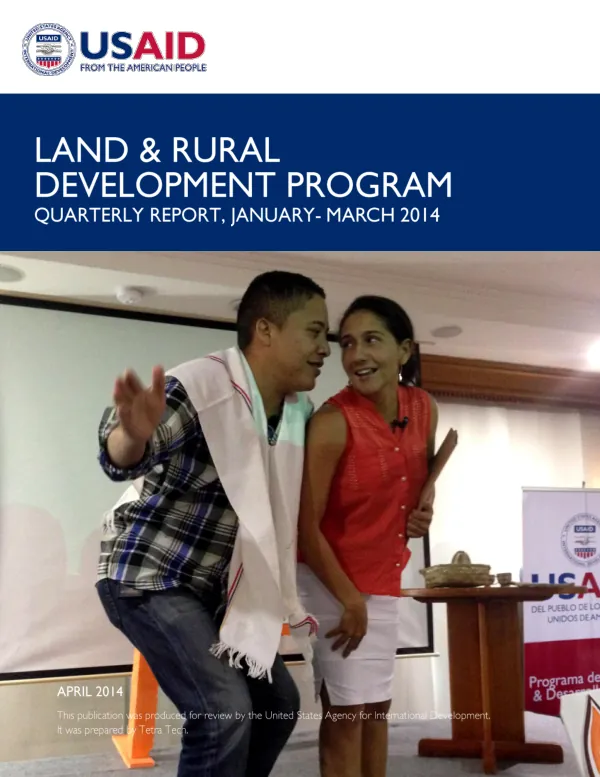
Land and Rural Development Program Quarterly Report, January-March 2014
The Land and Rural Development Program (LRDP) is a five-year task order funded by the United States Agency for International Development (USAID) under the Strengthening Tenure and Resource Rights (STARR) Indefinite Quantity Contract.
2014 · 42 pages
Sign in to readA free account is required to download.
Abstract
The program aims to assist the Government of Colombia (GOC) in strengthening its institutional capacity to develop tools, systems, and skills that will enable it to resolve land issues at the heart of Colombia's decades-long internal conflict. LRDP has four integrated objectives: to increase the capacity of the GOC to restitute land to the victims of conflict, to strengthen the capacity of the GOC to formalize rural property, to increase opportunities for sustainable licit rural livelihoods in conflict-affected areas, and to strengthen GOC capacity to monitor and evaluate restitution, formalization, and rural development programs. The program is based on the understanding that insecure property rights in rural areas are a root cause of conflict in Colombia, attributed to weak state presence. The accumulation of private and public properties by illegally armed groups and influential front men who used threats and violence to displace between 3.6 and 5.2 million people was facilitated by this lack of state presence. A marked decline in the quality of the lives of rural Colombians was exacerbated by low rural land tax revenues, contributing to a vicious downward spiral of weaker local governments and state presence, underinvestment in rural infrastructure, lack of key government services, and idle or inefficiently utilized land. Today, Colombia faces a unique window of opportunity: improved security, sensible macroeconomic policies, and growing tax revenues and royalties enabling the GOC to finance a comprehensive reparations program for victims as well as an expansion of infrastructure and public services in rural areas. The June 2011 Victims and Land Restitution Law endorsed compensating or reintegrating millions of victims and displaced landholders. Moreover, negotiations with the Revolutionary Armed Forces of Colombia (FARC) are opening the door to long-lasting peace and security, placing land and rural development reform on center stage. LRDP is being implemented through four components: Component 1, which aims to increase the capacity of the GOC to restitute land to the victims of conflict; Component 2, which aims to strengthen the capacity of the GOC to formalize rural property; Component 3, which aims to increase opportunities for sustainable licit rural livelihoods in conflict-affected areas; and Component 4, which aims to strengthen GOC capacity to monitor and evaluate restitution, formalization, and rural development programs. The program is being implemented in close collaboration with various stakeholders, including the GOC, local governments, civil society organizations, and the private sector. The program's success will depend on the effective implementation of its four components, as well as the ability of the GOC to sustain its commitment to land and rural development reform. The LRDP has made significant progress in its first quarter, with several key activities implemented. These include the establishment of a Land Restitution Unit, the development of a formalization program, and the implementation of a rural development program. The program has also made significant progress in building the capacity of the GOC to monitor and evaluate its programs. Overall, the LRDP is a critical component of the GOC's efforts to resolve the land issues at the heart of Colombia's internal conflict. The program's success will depend on the effective implementation of its four components, as well as the ability of the GOC to sustain its commitment to land and rural development reform.
Related documents