USAID
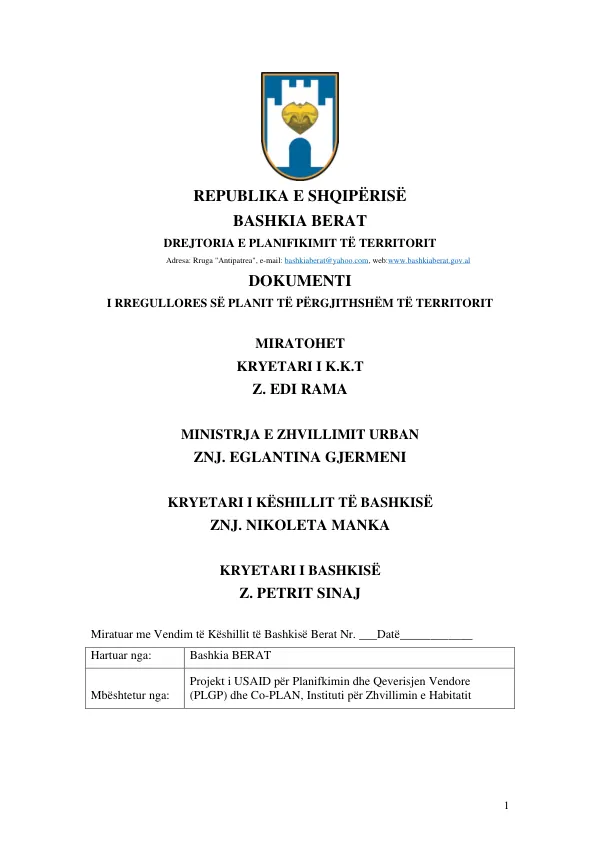
Rregullore e Planit të Përgjithshëm Vendor për territorin e bashkisë Berat
The General Urban Plan for the Municipality of Berat is a document that outlines the regulations for the development and use of land in the municipality.
2016 · 77 pages
Sign in to readA free account is required to download.
Abstract
The plan is based on the General Urban Plan for the Territory of Berat, which was approved by the Council of Ministers. The General Urban Plan for the Municipality of Berat aims to regulate the use of land in the municipality, taking into account the specific characteristics and needs of the area. The plan is divided into several chapters, each addressing a specific aspect of land use and development. Chapter 1 of the plan outlines the general provisions and objectives of the plan. According to Article 1.1.1, the plan is titled "General Urban Plan for the Territory of Berat Municipality." Article 1.1.2 states that the implementation of the plan is mandatory for all individuals and legal entities that operate, own, or reside in the territory of Berat Municipality, as defined by the plan's boundaries. The plan's boundaries are determined by the General Urban Plan for the Territory of Berat, which is based on the municipality's administrative boundaries. The plan's implementation is subject to the approval of the Council of Ministers and the Council of Ministers' decision on the plan's boundaries. Chapter 2 of the plan defines key terms, codes, and methodologies used in the plan. Article 2.1 defines the terms used in the plan, while Article 2.2 outlines the codes and methodologies used in the plan. Article 2.3 provides guidance on how to read and use the plan. Chapter 3 of the plan addresses the basic regulations for the use of land in systems, zones, and units. Article 3.1 outlines the systems, categories, and subcategories of land use, while Article 3.2 addresses the activities and functions of land use. Article 3.3 regulates the permitted, prohibited, and conditional uses of land, while Article 3.4 addresses the conditions for parcels, buildings, and structural units. Chapter 4 of the plan addresses the basic regulations for the division and consolidation of parcels. Article 4.1 outlines the conditions for the division of parcels, while Article 4.2 addresses the basic conditions for the consolidation of parcels for development purposes. Article 4.3 regulates the infrastructure and ownership conditions for parcels. Chapter 5 of the plan addresses the basic regulations for infrastructure and transportation. Article 5.1 outlines the categories of the road system according to the Road Code, while Article 5.2 addresses other categorizations and technical conditions of the road system according to the General Urban Plan. Chapter 6 of the plan addresses the basic regulations for the environment, landscape, natural resources, and cultural heritage. Article 6.1 regulates the basic conditions for developments that impact the environment, while Article 6.2 addresses the basic conditions for cultural heritage. Article 6.3 regulates the basic conditions for natural resources and water infrastructure, while Article 6.4 addresses the basic conditions for universal design. Chapter 7 of the plan addresses the basic regulations for the Development Permit, licenses, and development management instruments. Article 7.1 regulates the basic conditions for development permit zones, while Article 7.2 addresses the basic conditions for financial instruments for development management and the creation of public spaces and infrastructure. Article 7.3 regulates the basic conditions for licenses and construction. Chapter 8 of the plan addresses the basic regulations for each zone and unit. Article 8.1 regulates the basic conditions for the calculation of development indicators. The plan's implementation is subject to the approval of the Council of Ministers and the Council of Ministers' decision on the plan's boundaries. The plan's administrator is the Directorate responsible for the planning and development of the territory of Berat Municipality, which is responsible for the implementation of the plan and all regulations and procedures outlined in the plan.