USAID
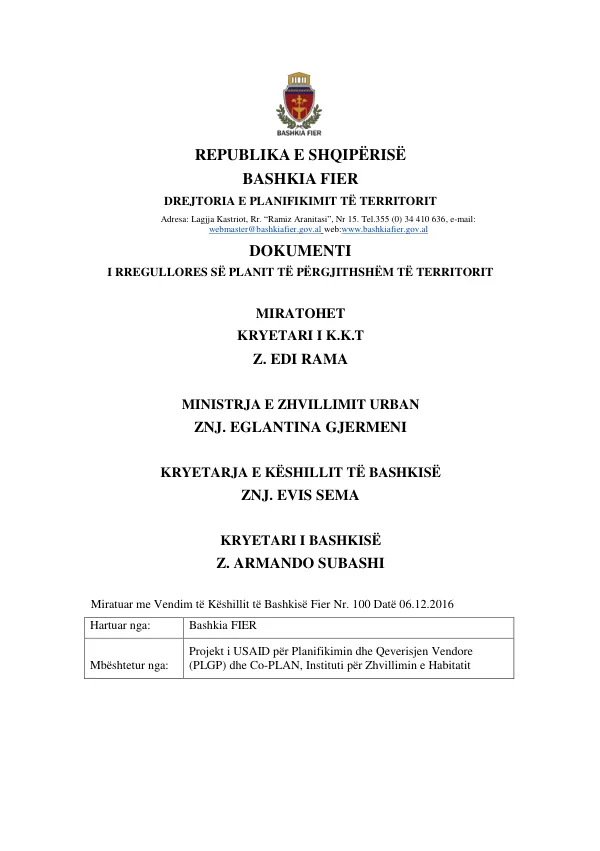
Rregullore e Planit të Përgjithshëm Vendor për territorin e bashkisë Fier
The General Urban Plan for the Municipality of Fier is a comprehensive document that outlines the regulations and guidelines for the development and management of the territory within the municipality.
2016 · 93 pages
Sign in to readA free account is required to download.
Abstract
The plan is based on the General Urban Plan for the Territory of Albania, which was approved by the Council of Ministers. The plan aims to ensure the sustainable development of the territory, taking into account the social, economic, and environmental aspects. It sets out the principles and rules for the use of land, infrastructure, and services, as well as the procedures for the implementation of development projects. The plan is divided into several chapters, each addressing a specific aspect of urban planning. Chapter 1 outlines the general provisions and objectives of the plan, including the definition of the territory, the scope of the plan, and the responsibilities of the administrator. Chapter 2 defines the terms, codes, and methodology used in the plan, including the classification of land use, the categorization of infrastructure, and the procedures for the implementation of development projects. Chapter 3 sets out the basic regulations for the use of land, including the classification of land use, the categorization of infrastructure, and the procedures for the implementation of development projects. It also defines the permitted, prohibited, and restricted uses of land. Chapter 4 outlines the basic regulations for the division and consolidation of parcels, including the procedures for the division and consolidation of parcels, the requirements for the creation of new parcels, and the procedures for the transfer of ownership. Chapter 5 sets out the basic regulations for infrastructure, including the classification of infrastructure, the categorization of infrastructure, and the procedures for the implementation of infrastructure projects. Chapter 6 outlines the basic regulations for the environment, landscape, natural resources, and cultural heritage, including the procedures for the protection and conservation of the environment, the procedures for the management of natural resources, and the procedures for the protection and conservation of cultural heritage. Chapter 7 sets out the basic regulations for the Development Permit, licenses, and instruments for the management of development, including the procedures for the issuance of development permits, the procedures for the issuance of licenses, and the procedures for the implementation of development projects. Chapter 8 outlines the basic regulations for each zone and structural unit, including the procedures for the implementation of development projects, the procedures for the issuance of development permits, and the procedures for the management of infrastructure. The plan also includes several annexes, including the codes for the classification of land use, the table of roads, and the passport for development for each structural unit. The plan is administered by the Directorate for Territorial Planning, which is responsible for the implementation and enforcement of the plan. The plan is subject to periodic review and revision, with a review period of 15 years. Any changes to the plan must be approved by the Council of Ministers and the Council of Ministers for Territorial Planning. The plan is an important tool for the sustainable development of the territory, and its implementation is crucial for the protection and conservation of the environment, the management of natural resources, and the promotion of economic growth and social development.