USAID DEC
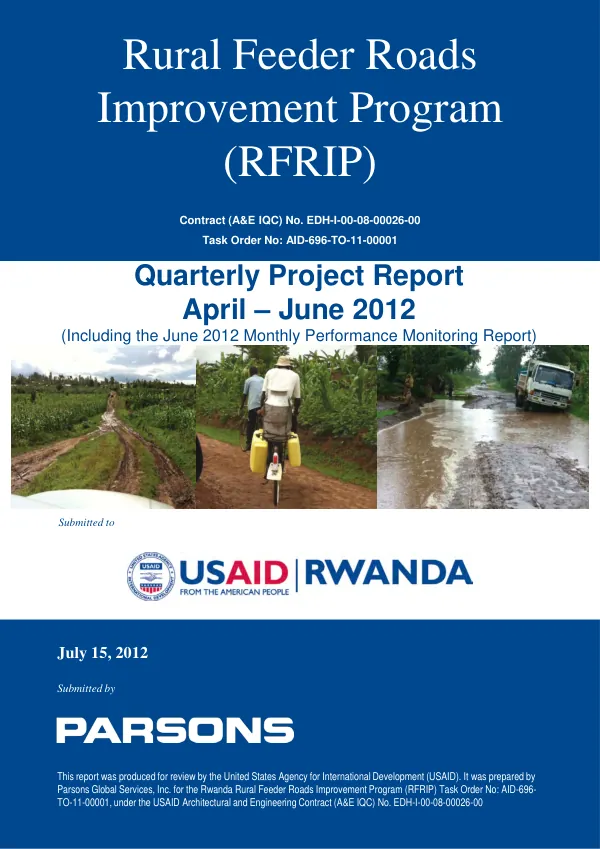
Rural Feeder Roads Improvement Program (RFRIP) Quarterly Project Report April – June 2012
Sign inUSAID
Rural Feeder Roads Improvement Program (RFRIP) Quarterly Project Report April – June 2012
The Rural Feeder Roads Improvement Program (RFRIP) is a project aimed at improving rural feeder roads in Rwanda.
2012 · 50 pages
Sign in to readA free account is required to download.
Abstract
The program is funded by the United States Agency for International Development (USAID) and is implemented by Parsons Government Services, Inc. under Contract (A&E IQC) No. EDH-I-00-08-00026-00 and Task Order No: AID-696-TO-11-00001. The project's objective is to improve the condition and accessibility of rural feeder roads, which are critical for economic growth, poverty reduction, and social development in Rwanda. The program focuses on upgrading existing roads, constructing new roads, and improving road maintenance practices. During the April-June 2012 quarter, the project team made significant progress in implementing the program's activities. The team conducted a road inventory and prioritization exercise, which identified 1,200 kilometers of roads that require upgrading or construction. The team also prepared technical designs for 300 kilometers of roads and provided procurement support for the construction of 100 kilometers of roads. The project team also conducted capacity-building activities, including training for road maintenance personnel and provision of equipment for road maintenance. The team also established a road maintenance program, which includes regular maintenance activities, such as pothole repair and drainage improvement. The project's budget for the April-June 2012 quarter was $1,219,987, which is 38% of the total budget for the first year. The project's total budget for the five-year period is $9,935,980. The project team encountered several challenges during the quarter, including delays in procurement and construction activities, and difficulties in accessing remote areas. However, the team was able to overcome these challenges through effective project management and coordination with stakeholders. The project's performance monitoring plan includes regular reporting on progress, budget, and financial performance. The project team also conducts regular meetings with stakeholders, including the Government of Rwanda, to discuss progress and address challenges. The project's implementation is expected to continue through August 2016, with a total of 1,500 kilometers of roads to be upgraded or constructed. The project's success will depend on effective project management, coordination with stakeholders, and timely completion of activities. The project's geographic focus is on rural areas in Rwanda, with a particular emphasis on districts with high poverty rates and limited access to markets. The project's implementation is expected to have a positive impact on the lives of rural communities, including improved access to markets, increased economic opportunities, and enhanced social services. The project's timeframes are as follows: the project began on August 12, 2011, and is expected to be completed on August 11, 2016. The project's budget is $9,935,980, with a total of $3,219,987 allocated for the first year. The project's recommendations include continued support for road maintenance activities, provision of equipment and training for road maintenance personnel, and establishment of a road maintenance program. The project team also recommends continued coordination with stakeholders, including the Government of Rwanda, to ensure effective implementation of the project.
Related documents