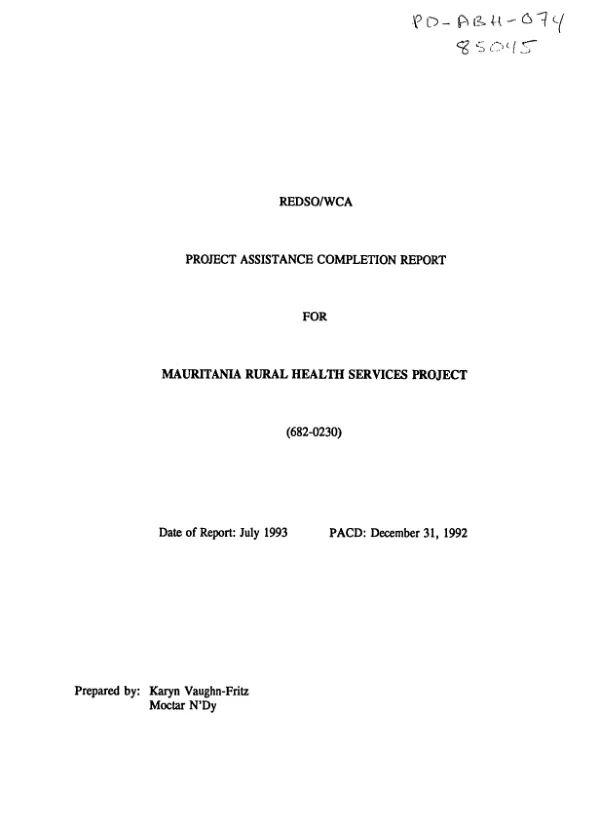
USAID. MISSION TO MAURITANIA
Rural health services project
Summarizes an attached mid-term evaluation (XD-AAU-717-A) of a project to improve the Government of Mauritania"s (GIRM) Expanded Program of Immunization (EPI) and to develop an expanded and integrated community-based primary health care (PHC) system in three regions.
1986
Sign in to readA free account is required to download.
Abstract
The evaluation covered the period 1983-10/86 and was based on document review, site visits, and interviews with Ministry of Health (MOH) personnel. The project is progressing steadily despite a number of problems. The PHC program has successfully accomplished its most difficult task: establishing a functional supervisory system. It has also developed a schedule of activities, tasks, and performance expectations, and has accommodated the conflicting objectives and roles of integrated mobile teams. The MOH has established a model PHC system at Trarza - now entering a maintenance phase - which seems workable and replicable; thus, the PHC program can now be extended to the two other target regions as well as to other parts of the country. The EPI program has been exceptional, largely due to its use of a mixture of innovative strategies and interventions; over 50% of the target population has been vaccinated through the use of mobile teams, maternal child health centers, and National Vaccination Days. There are continuing problems, however, in logistics, procurement, and the maintenance of vehicles and cold chain facilities. Project management has been variable. Personnel conflicts have disrupted the delivery of long-term TA, and short-term TA was not satisfactorily provided. Commodity delivery has generally been good but hindered by a poorly working vehicle. A pharmaceutical and a medical-anthropological study were funded, but neither led to follow-up actions. Training has been without problems except for trainees" dissatisfaction with A.I.D. per diem (compared to other donors"). Finally, the MOH has been beset with organizational problems relating to the division of tasks and responsibilities, rapid personnel turnover (including the loss of key, experienced personnel), a lackluster performance by the project"s first director, and the slow resolution of problems requiring GIRM decisions and actions. Still, on balance, local inputs have been forthcoming and of good quality. Due to an avoidably slow start-up, the project will probably eventually have to be extended to meet all objectives. The project would benefit from a new implementation plan - the current plan is too complex and depends on a wide variety of actors and the realization of scattered, disparate outputs. This seems to be a common fault of A.I.D. project design. Action decisions include hiring long-term EPI, management information system, and operations research advisors and extending the PHC component to the Guidimaka region.