USAID DEC
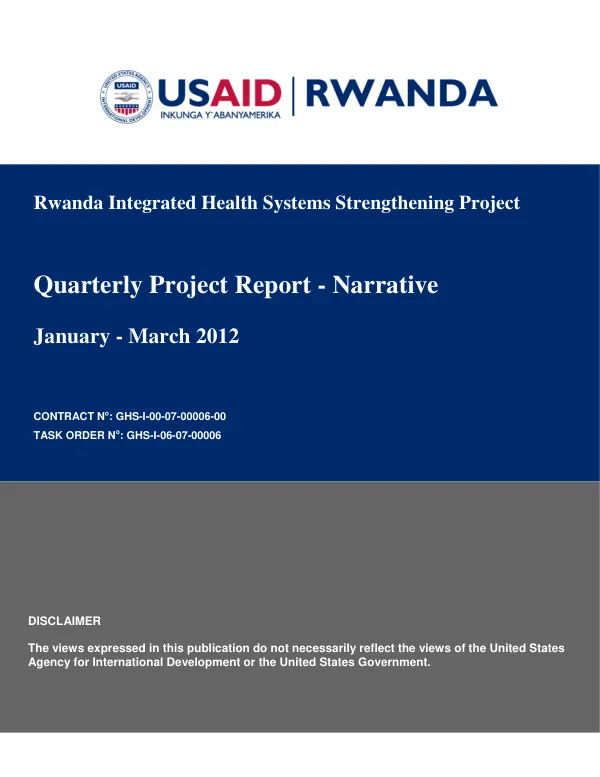
Rwanda Integrated Health Systems Strengthening Project Quarterly Project Report - Narrative January - March 2012
Sign inMINISTRY OF HEALTH
Rwanda Integrated Health Systems Strengthening Project Quarterly Project Report - Narrative January - March 2012
The Rwanda Integrated Health Systems Strengthening Project is a 5-year initiative launched in November 2009, funded by the United States Agency for International Development (USAID).
2012 · 34 pages
Sign in to readA free account is required to download.
Abstract
The project aims to improve financial and geographical accessibility for all Rwandans to quality health services that are sustainable and efficiently managed by well-trained health sector staff with clear functional responsibilities. The project focuses on four key components: improved utilization of data for decision-making and policy formulation, strengthened health financing mechanisms, improved management and quality of human resources for health, and improved quality of health services through standardized approaches. The project seeks to address priority gaps in the Rwandan Health System and contribute to the overall vision of a well-functioning health system. The project's first component, improved utilization of data for decision-making and policy formulation, involves upgrading the Performance-Based Financing (PBF) and Community-Based Health Insurance (CBHI) web-based applications, as well as the health and management information system (HMIS). The project also supports the Rwanda Health Enterprise Architecture (RHEA) and the human resources for health information system (iHRHIS). In the second quarter of 2012, the project made significant progress in this component. The PBF and CBHI web-based applications were upgraded, and the HMIS was also upgraded. The project supported the development of the RHEA and the iHRHIS. Additionally, training was provided to data managers in the use of DHIS-2 and the new HMIS reporting tools. The project's second component, strengthened health financing mechanisms, involves supporting the development and implementation of the CBHI, as well as conducting studies and system analysis. The project also supports the performance-based financing program roll-out and data analysis, as well as the institutionalization of healthcare costing. In the second quarter of 2012, the project made significant progress in this component. The CBHI was developed and implemented, and studies and system analysis were conducted. The project also supported the performance-based financing program roll-out and data analysis, and the institutionalization of healthcare costing. The project's third component, improved management and quality of human resources for health, involves assisting the Ministry of Health to revise the human resources for health policy to address current needs, as well as supporting the Ministry's capacity to manage human resources development through continuous professional development (CPD). The project also supports the health professional licensing process. In the second quarter of 2012, the project made significant progress in this component. The Ministry of Health revised the human resources for health policy, and the project supported the Ministry's capacity to manage human resources development through CPD. The project also supported the health professional licensing process. The project's fourth component, improved quality of health services through standardized approaches, involves reviewing and developing health service packages, clinical protocols and treatment guidelines, and district hospital operational policies and procedures. The project also reviews and harmonizes patient files. In the second quarter of 2012, the project made significant progress in this component. Health service packages were reviewed and developed, and clinical protocols and treatment guidelines were developed. The project also reviewed and harmonized patient files. The project's cross-cutting technical assistance involves supporting health sector strategic planning (HSSP III). In the second quarter of 2012, the project made significant progress in this component, supporting the development of the HSSP III. The project's activities scheduled for the next quarter include continuing to support the development and implementation of the CBHI, as well as conducting studies and system analysis. The project also plans to support the performance-based financing program roll-out and data analysis, as well as the institutionalization of healthcare costing.
Related documents