MINISTRY OF HEALTH
UHSS Quarterly Report: Program Year 5 Quarter 1
The Uganda Health Systems Strengthening (UHSS) Activity is focused on improving the performance of Uganda's health systems through technical assistance (TA) and capacity building.
2024 · 33 pages
Sign in to readA free account is required to download.
Abstract
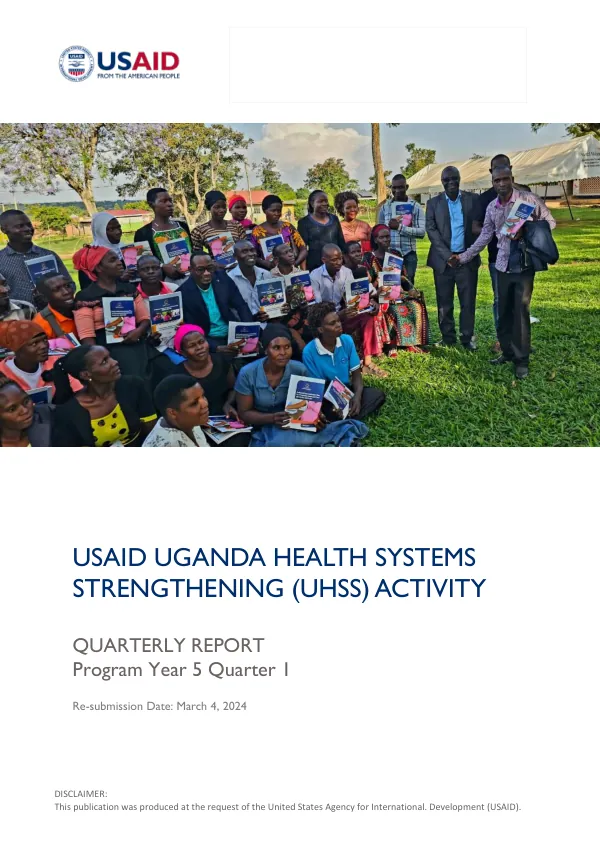
The Activity aims to strengthen leadership and accountability for results in the public and private sector, improve efficient use and management of key health systems resources, and strengthen community systems. During Project Year 5 (PY5) quarter one (Q1), UHSS implemented TA activities in the United States Agency for International Development (USAID)-supported districts and provided support to the Ministry of Health (MoH), Regional Referral Hospitals (RRHs), Districts, and the private sector, including private-for-profit entities. Key achievements during this period include the finalization of the RRH Board self-evaluation and performance monitoring tools, the generation of the first draft of the National Health Account (NHA) report for financial year (FY) 2019/20 and 2020/21, and the submission of the draft health subprogram Budget Framework Paper (BFP) for FY 2024/2025 to the Ministry of Finance, Planning, and Economic Development (MoFPED). UHSS also supported the MoH in finalizing the costing of the Community Health Extension Worker (CHEW) pilot program in the three pilot districts using the Ingredients-Based Approach. The results from the costing analysis showed that the overall unit financial cost for delivering the CHEW program in one year, including national level coordination costs, was at UGX 20,928,862 per CHEW. Additionally, UHSS reached 7,095 community members with malaria prevention and reduction messages through 112 follow-up dialogue meetings, which provided a platform for demonstrating the correct use, care, and storage of long-lasting insecticidal nets (LLIN). This intervention led to a reduction in malaria positivity by 6 percent, dropping from 56 percent in the previous quarter to 50 percent in October-December 2023 across the 14 sub-counties that were reached with community engagements. The Activity also tracked the uptake of immunization funds, with 97 percent of CDC/DoD districts and half of the cities accounting for 51 percent of immunization funds between October and December 2023. This allowed districts to access additional funds from donors. Furthermore, UGX 3.8 billion was processed and paid to health workers using the E-cash system. Lessons learned during the quarter include the importance of institutionalizing NHA processes for sustainability, the critical role of in-person engagement with stakeholders in the development of RRH board reporting tools, the potential for cost savings during the start-up phase of the CHEW program by utilizing shared resources, and the need to scale the CHEW program within hard-to-reach communities. The UHSS Activity will continue to track the uptake of vaccines in Q2 and provide support to the MoH, RRHs, Districts, and the private sector to strengthen health systems in Uganda.